<body><script type="text/javascript"> function setAttributeOnload(object, attribute, val) { if(window.addEventListener) { window.addEventListener('load', function(){ object[attribute] = val; }, false); } else { window.attachEvent('onload', function(){ object[attribute] = val; }); } } </script> <div id="navbar-iframe-container"></div> <script type="text/javascript" src="https://apis.google.com/js/platform.js"></script> <script type="text/javascript"> gapi.load("gapi.iframes:gapi.iframes.style.bubble", function() { if (gapi.iframes && gapi.iframes.getContext) { gapi.iframes.getContext().openChild({ url: 'https://www.blogger.com/navbar/6246235?origin\x3dhttp://kevinagee.blogspot.com', where: document.getElementById("navbar-iframe-container"), id: "navbar-iframe" }); } }); </script>

Not Watchin' The Road

Friday, January 27, 2006

As easy as it is to fall into a "the world is against my baseball team" mindset when "my baseball team" is the Kansas City Royals, I’m surprised that I stayed out of the muck this long. With that said, I’ve never, ever believed that ESPN and other national media outlets make a concerted effort to avoid talking about small-market baseball, at least in a vicious sense.

Sure, in a perfect world, all 30 clubs would receive equal airtime, but the reality of the situation is that networks and newspapers do what they can to sell their product. For a myriad of reasons, the Yankees and Red Sox are interesting, while the Royals and Pirates are not. That the Royals aren’t talked about has nothing to do with their small-market status; it’s because they don’t win and don’t have any drama.

However, while it’s one thing for network executives and newspaper editors to make decisions that are in their best interests, it’s quite another for a publication to display pure and unabatedly-lazy journalism. Baseball America recently released their acclaimed Prospect Handbook for the 2006 season and BA’s Will Kimmey wrote the Royals’ organizational review. Within Kimmey’s published essay was this sentence:

    While Baird has played his part, the downward spiral began in 1993 when CEO David Glass bought the club and began running it like a discount store.
Really? If Mr. Kimmey is reading this, he should probably be aware that while Glass essentially ran the club as Chairman following the death of Royals founder Ewing Kauffman in 1993, it was essentially owned by a community trust until Glass finally made the purchase for $96 million. In 2000.

Glass being the man in charge of finding ownership might have been what Kimmey meant by "bought the club," but that doesn’t make the mistake any less horrible than it already is. After all, the people who edited the book are paid to find errors like this, so they failed to do their jobs as well.

To make matters worse, Chris Demaria is ranked as Kansas City’s 25th-best prospect more than a month after he was traded to the Brewers, while other prospects who changed teams this winter – Andy Marte and Yusmeiro Petit come to mind – are listed with their new teams. Jonah Bayliss and Chad Blackwell, the two young pitchers who were traded to Pittsburgh for Mark Redman during the Winter Meetings, are listed on the club’s depth chart. Oh, and Billy Butler was apparently born on his draft date, or June 7, 2004.

I don’t feel wronged as a Royals fan by these easily fixable errors, but I do find myself a little bit discouraged that a publication as prestigious as BA didn’t catch this kind of stuff before they published the book. Maybe it is or maybe it isn’t a sign that they don’t care enough about the Royals to go over their section with a fine-toothed comb. I don’t know, and I don’t care. BA’s better than this and I hope they right the ship.

A Rehashed Rumor

Wednesday, January 25, 2006

I guess we should be surprised that it took this long.

Thanks to FOXSports.com's Ken Rosenthal, the trade rumors involving Cincinnati Reds outfielder Austin Kearns have started again and, as usual, the Royals are named as a potential suitor for the 25-year-old. According to Rosenthal's report, the Royals have not been willing to include Zack Greinke in any deal (and rightfully so), but may be willing to move Mike MacDougal or Jeremy Affeldt.

A large part of Rosenthal's report is just speculation based Cincinnati's new owner wanting changes made and Kearns being the player who'll likely net the Reds the most talent in a trade. Additionally, the outfield logjam that included Kearns, Adam Dunn, Ken Griffey, Jr. and Wily Mo Pena was solved when former GM Dan O'Brien opened up first base for Dunn by trading Sean Casey to Pittsburgh, but for the sake of discussion, I'll assume that the story has some merit beyond the reasonable assumptions it makes.

I've long been a fan of Kearns, whose combination of on-base skills and mammoth home run power have been rather prevalent throughout his professional career. The phrase, "he's hit everywhere he's been" definitely applies to him, as the lowest OPS he's posted at any level including the Majors is .812, which he accomplished in 125 at-bats in Rookie ball. Statistically, Kearns' power is matched by few, as his slugging percentage in the minor leagues is a healthy 229 points higher than his batting average. From a visual standpoint, the 6-3, 245-lb. former first-rounder can hit a pitched baseball a country mile, making him a likely fan favorite.


Generally speaking, players with Kearns' hitting skills aren't dangled from a hook as trade bait in consecutive seasons, leaving us with the reason he's apparently still available to any team willing to ship the Reds some pitching help in return: injuries. Kearns has only gotten in 365 games over his four seasons for reasons varying from frequent hamstring pulls to scar tissue in his right thumb.

Since Kearns is still young, it's difficult to say if his issues with staying on the field are a result of his build, bad luck, bad conditioning, or a combination of the three. Regardless, it raises a red flag, and is definitely why no team to date has been willing to meet the Reds' asking price.

Ultimately, whether or not the Royals believe they can solve Kearns' injury problems may be the determining factor in whether or not they choose to seriously pursue a trade. If acquired and healthy, Kearns would presumably take over the left field duties from Emil Brown, who would likely become the team's fourth outfielder and play against left-handed pitchers.

If he could remain injury-free for 130+ games a season, Kearns would be a very nice addition to a potent lineup that'll include David DeJesus, Billy Butler, Alex Gordon, and Justin Huber very, very soon.

Sensible Lineups? No Such Thing...

Friday, January 20, 2006

Growing up, I never really had a taste for or a desire to listen to any kind of music. I knew that bands like Matchbox 20, The Goo Goo Dolls, Bush, and Green Day existed, but unlike the rest of the kids I was in school with, I don’t think I listened to any band’s CD until I was in 8th grade. Looking back on it, I guess my excuse is that I simply never had a connection with any of those bands or the types of songs they wrote. Despite being a pretty good trumpet player from 1997 to 2003 and experiencing an increased level of interest in music during my first two years of high school, I still hadn’t found that one artist (or even that one song) with such a captivating sound, it made me drop whatever I was doing and really listen.

Then in August of 2001, I heard John Mayer’s No Such Thing on the radio, and I was instantly hooked. Sure, I had absolutely no idea at the time that the song was called No Such Thing or that it was written and performed a guy named John Mayer, but I knew I wanted to find that information as soon as possible. After all, popular/rock music finally made sense to me, and I wasn’t about to let it go. A short while after, I headed out, bought Room For Squares, Mayer was well on his way to becoming the Official Musician of KRB.

Quite simply, Mayer just worked for me. I understood where he was coming from. Not only did the sound of the music work – and sound is the most important aspect for me – but the lyrics made tons of sense as well. I completely related to the words in most of the songs on Squares, but No Such, Why Georgia, My Stupid Mouth – the first three tracks on the album – especially stood out. Listening to those was (and still is) therapeutic, like hearing my own daily thoughts in song form.


Fast-forwarding to the present, Mayer’s made a 180-degree turn by forming the John Mayer Trio and releasing Try!, the group’s first CD. Despite changing his music from quiet rock to more of a blues and old school rock sound and altering his appearance to fit the new genre, the connection I have with his work is continuing. A lot of that connection has to do with the fact he can play the hell out of a guitar, but once again, the music itself – Who Did You Think I Was and Try specifically – perfectly describes how hard I try to be completely different from everybody else in my daily life.

So for all those years, maybe I was just searching for an artist who seemed to understand where I was coming from. I’m thankful I found that artist, because through his songwriting, Mayer’s helped me find answers in this still verdictless life.

With that said, here are a few Royals notes, what you really came here for...

  • Sometime in the last few days the Royals released a list of the players they've invited to spring training to date. Chris Richard could probably serve as an adequate fill-in at a corner outfield spot and 33-year-old Mike Coolbaugh's a little bit intriguing since he's hit in the minor leagues, but aside from Alex Gordon (who won't make the club), nobody on the list has any business being on the 25-man roster. That goes double for Joe McEwing, despite being the only superhero in baseball history.


  • Since we appear to be stuck with this awful idea, I really want to take the World Baseball Classic seriously, but I have a hard time getting behind it when New York-born David DeJesus will suit up for Puerto Rico, California-born Mark Teahen is on Canada's roster, and Illinois-born Justin Huisman is listed with the Netherlands alongside Shea Hillenbrand, who is a native of Arizona.

    I realize that countries without any real baseball history like Italy and the Netherlands have to stretch a ways to fill their rosters, but seriously, what's really the point of their participation or even the tournament itself if players are taking the field for countries they've probably never visited? Here's an idea: have those born in America play for America, those born in Canada play for Canada, and so forth. That, or just ditch the thing altogether.

    I'm voting for the latter.


  • Royals manager Buddy Bell on why Mark Grudzielanek will hit second this year:

    "He's done it before, he understands situations," Bell said. "He doesn't freak out."

    It's amazing how something as simple as understanding how a lineup works has been twisted over the years. I've said this before, and I'm probably going to be saying it many times again as we head towards Opening Day: The point of a lineup is not to set up innings, and each spot in the order most definitely does not have its own responsibilities. In other words, the leadoff guy can be slow on the basepaths, the second hitter in the order does not have to be a good bunter, the third isn't required to be the team's best hitter, and the fourth shouldn't always be the team's "best RBI guy."

    Ultimately, the only time the order matters as far as situations go is in the first inning when your team starts at the top. And since nobody should EVER lay down a sacrifice bunt in the first inning, it shouldn't even matter then. A team will have all sorts of slot combinations due up in subsequent innings, leaving us with a lineup's main objective: to get the best hitters the most plate appearances, thereby maximizing any team's chances of scoring runs.

    How is that so complicated? Most people understand that a team's very worst hitters should hit at the bottom of the order, so why don't they understand that a team's very best should hit at the top? Bizarre.

    If the Royals really wanted to break new ground and, more importantly, win more games, they'd hit DeJesus leadoff, Mike Sweeney second, Reggie Sanders third, and so on until they got to the out machines in the bottom third. Unfortunately, the man in charge in KC is just like the other 29 managers in MLB, who all probably think that "understand[ing] situations" is the most important trait for all second hitters to have.

    Hitting talent? What's that?
  • The End of the Line

    Wednesday, January 18, 2006

    Just as I expected, The Real Question – my sprayahen.com article about steroids – rankled the feathers of at least one valued KRB reader. I’m still not sure how stating that it’s far more important to gather evidence, learn, and ask the right questions about drug usage in baseball than it is to make hurried judgments is almost always heard as, “I don’t think steroids are a problem,” but it happens, and people get upset over it. I’ve never seen a sports topic that spawns such raw emotion out of ordinary people, and that includes the media-induced “Stats v. Scouts” heavyweight bout that must be in round 2,532 by now.

    Such discussion isn’t a bad thing, though, as dialogue, research, and education are three necessary components baseball must use towards reaching a solution that will rid the game of ‘roids. But as that is an ongoing process, let’s move on to more positive matters, agree that Scarlett Johansson is a jaw-dropping bombshell, and talk some Royals baseball.

    The Royals avoided arbitration with pitchers Runelvys Hernandez and Jeremy Affeldt by signing both to one-year contracts yesterday. According to rotoworld.com, Hernandez is set to earn a base salary of $1.225 million, while Affeldt will pull in $1 million. Both posted ERAs over 5.00 last year but both received raises, providing more evidence that being a Major League baseball player has to be the sweetest way to earn a living in the known universe.

    Earlier this winter, Royals GM Allard Baird said that Hernandez – who has never been commended for his work ethic – would have to “come in in shape and compete for a [starting pitching] job,” but I seriously doubt he’ll have to compete harder than, say, Mike Wood is going to have to in order to be moved out of the bullpen. I don’t believe in jobs being won or lost in spring training games, but realistically, Hernandez would have to completely tank in Surprise to lose his grip on the fourth starter’s spot in the rotation to Wood, Jimmy Gobble, Denny Bautista, or J.P. Howell.

    Aside from being Bartolo Colon’s fellow Clown Perm Hall of Fame member, I’ve never been sure what exactly the Royals see in Hernandez that’s made them promote him as a viable option in the starting rotation. Following a strong minor league career and a solid showing in a half-season’s work in 2002, Hernandez has only seen his production slip downhill, especially in the control department:


    ERA SO/9 BB/9
    2002 4.36 5.45 2.66
    2003 4.61 4.71 3.63
    2004 ****OUT FOR SEASON****
    2005 5.52 4.96 3.95

    '

    Given the sudden and seemingly random drop in his 2003 ratios, it’s entirely possible that Hernandez blew out his elbow during or after the 2002 season. Sure, his ERA in April of 2003 was a miniscule 1.60 in 34 2/3 innings of work, but his strikeout-to-walk ratio was a weak 16-to-15, leaving little doubt that he’d soon “make up” for the runs he wasn’t allowing. In his next 52 innings, Runelvys was pounded for 63 hits and 41 earned runs before finally revealing that he experienced quite a bit of pain in his elbow with every pitch.


    I’d like to say that, as it is for many pitchers who’ve undergone Tommy John surgery, Hernandez will be infinitely better in his second full season after the operation. Unfortunately, I can’t. For one, he isn’t particularly young like Kerry Wood was in 1999; he’s going to be 28 years old, meaning what we see now is likely what we’re going to get for awhile longer. Additionally, I don’t think his quality-of-stuff was particularly high to begin with, and his inability to keep from gaining a lot of weight as the season progresses is only going cause him to lose strength and effectiveness when the temperature rises during the summer.

    Unless the Royals are convinced that the last time Hernandez was actually healthy was in 2002, I don’t think they have any business looking at him as a long-term solution. I think he’s a below-average innings-eater at the very best, but if he can help hold down the fort while guys like Howell and Bautista develop in low-pressure situations in preparation for the 2007 season, I can live with his very large presence making 32 starts.

    While Hernandez is penciled into the rotation behind Scott Elarton, Mark Redman, and Zack Greinke, the last spot is still very much up for grabs. Because of his experience, another ligament transplant patient, Joe Mays, is probably Buddy Bell’s preference as we speak. After some careful thought, I’m not so sure that’s as bad of a thing as I originally believed.

    After his breakout 2001 season when he threw more than 234 innings of 3.16 ERA ball for Minnesota, Mays’ star fizzled in 2002 and 2003, throwing a combined 225 1/3 innings and posting a 5.92 ERA. However, like Hernandez, Mays likely pitched all of two seasons with a bum elbow, missed all of 2004 while rehabbing, and really struggled in 2005.

    The good news (yes, this is good news) is that most of Mays’ 2005 struggles came after the All-Star break. In the first half, his strikeout rate was very sub-par (3.03 per nine innings pitched) in 98 innings, but he was still able to post a 4.13 ERA because of outstanding control (2.02 per nine innings pitched). After the break, Mays hit a wall, allowing a .351 opposing batting average en route to an unsightly 8.22 ERA. Terrible production from any pitcher, of course, but it wasn’t at all surprising that he simply tired out in his first full year back.

    I think that leaves some room for real optimism, although it comes with a catch: Mays is never going to strike out more than 5.50 batters per nine innings, so to give the Royals quality innings, he’s going to have to locate his sinker exceptionally well, induce weak-contact ground balls, and have an improved infield defense make plays behind him.

    Mays will have to fight off Affeldt who’s undoubtedly coming into camp hungry, as the Royals instructed him to condition himself this winter to be a starting pitcher. Again.


    I really believe this is Affeldt’s last chance to turn his sometimes-unhittable stuff into almost-always-unhittable stuff in Kansas City, giving the Royals the horse they thought they’d get in 2004. However, I’m not sure they’re completely justified in turning him back into a starter:


    2003-2005
    ERA H/9 SO/9 BB/9
    As Reliever 4.28 8.91 8.26 4.13
    As Starter 4.67 10.39 5.35 3.06

    '

    The most curious trend there is that while Affeldt's control improves as a starter, his command within the strike zone weakens. His ERA is roughly the same, but as a result of the lower strikeout rate, he’s been much more hittable as a starter. From what I’ve seen, most of that isn’t really because of a lack of ability to start games, but rather that he tends to pitch between 88 and 92 mph as a starting pitcher when he has the ability to throw 95 mph routinely. He might need to pace himself, but in my mind, if you can throw in the mid-90s, there’s absolutely no reason to dial it back for worry of endurance. Hopefully, the extra work he did this winter and a new pitching coach will get him to pitch the way he’s capable. Big-time results await if he does.

    Stuff to Read

    Tuesday, January 17, 2006

    KRB has returned from its long weekend, but after quite a bit of searching with virtually no results, I unfortunately don't have anything new for you today. As a result, I'll use today to plug articles at the other two sites I'm affiliated with...

    Today at Royals Corner
    An Interview With Billy Butler (By Dave Sanford)

    Today at Sprayahen
    The Real Question (By Kevin Agee)
    Expanding My Baseball Horizons (Part Two) (By Brian Vaughan)

    KRB's Talk with Dave Haller

    Thursday, January 12, 2006

    Last night, KRB spoke with BaseballProspectus.com writer Dave Haller about the Battle of Champions, the Royals, and his time working for the leader in baseball analysis:

    KRB: You joined the Baseball Prospectus (BP) team as an intern in December of 2004. Here we are a year later, and you’ve made a meteoric rise from being a research assistant to writing feature-length articles, and even gaining the title of “staff writer.” How has your time at BP affected your life from a baseball standpoint?

    DH: I find myself wondering about what things we know, what we don’t, and what we may never know about baseball, but more than anything, the big part of the experience has been getting to hear ideas from the great baseball minds at BP. After working with those people and seeing the inspirations and opinions behind their own articles that deal with so many teams, it’s also become easier to focus on more teams in baseball besides my Cleveland Indians.

    KRB: You visited the Beacon Orthopedic Clinic with Will Carroll last spring and wrote a fantastic article about the things you saw there. Tell me about that experience.

    DH: Beacon really is a state-of-the-art facility in every way, and I got to meet Tim Kremchek, who is one of the more prominent physicians at all levels of baseball. It really was a privilege and an honor just to listen to the dialogue between two medical minds like Dr. Kremchek and Will.

    I never pitched, so I didn’t understand the devastation on very young arms. Tommy John surgery (which Kremchek regularly performs) is a medical miracle and routinely saves careers for the right reasons, but although working young pitchers hard isn’t nearly as accepted as it used to be, there are still signs of abuses of the system. As an example, when dads and coaches say, “I’m gonna have my kid get a Tommy John operation so he’ll throw 10 mph faster,” that’s a problem because it doesn’t work like that. It’s also important for the kid to know the difference between soreness and pain.

    KRB: Let’s turn to the Battle of Champions. It’s one of the most interesting ideas I’ve ever seen Prospectus come up with. You guys started talking about it in October after Bobby Valentine remarked that his club could beat the White Sox in a best-of series. How did it start, and what was the goal of the project? Did you reach it?

    DH: After Bobby made his comment, somebody at BP – I can’t remember who – came up with the idea. We worked on it bit-by-bit, developing the players using Clay Davenport’s translations and so forth. It was a very long process to put together.

    More or less, the goal was just to put two evenly-matched, pitching-oriented teams together in a series, sim it, and see what would happen. I have a hard time drawing any real-world conclusions from the results, but it was definitely worthwhile.

    KRB: You did the simming and the write-ups, so did you notice any trends during the process?

    DH: The batting average on balls in play seemed high, but Chiba’s stadium plays favorably for doubles and triples. I didn’t really have time to go back and heavily review the stats, so no, I didn’t see any real specific, interesting trends that would mean anything. More than anything I think it just reinforces the fact that anything at all can happen in a short series, whether it’s in real life or simulation.

    KRB: Valentine basically started this whole thing. What does he think of it?

    DH: [Laughing] Will Carroll actually approached Bobby about it at the Winter Meetings and offered him a chance to actually manage his team in the simulation. He politely declined, but if he ever changes his mind, we’ll run the series again!

    KRB: Moving to the Royals. Putting aside the player personnel mistakes the team made three and four years ago that are still hurting the organization today, what, in your opinion, is the number one thing standing between Kansas City and a winning ballclub?

    DH: I think the huge problem Kansas City has is that the big names won’t sign there, and, with the exception of Mike Sweeney who’s very overpaid, the team’s best home-grown talent (Carlos Beltran) won’t stick around. I’ve never been to Kansas City or to [Kauffman Stadium], but I’m sure the issue isn’t the people or the city, it’s the losing. Breaking out of a losing cycle is a big challenge, because if good players won’t sign with your club, it becomes even more difficult to get better and turn it back into a desirable place to play.

    KRB: The Royals have a solid offensive core on the way up that should be an 800-plus run unit for at least three or four years, but my concern is where the starting pitching will come from.

    DH: Well, there’s no question that KC’s track record of developing starting pitching is bad enough to raise a few warning signs. I’m trying to think of any pitchers who’ve lived up to their potential, and I’m only coming up with Zack Greinke, and that’s if he’d pitched as well in 2005 as he did in 2004.

    Scott Elarton’s contract is a little bit of a risk, but I think acquiring [veteran] starting pitchers makes some sense if it allows the young ones to develop in the minor leagues, therefore not crushing them in the majors. I mean, there definitely aren’t many 21- or 22-year-old pitchers out there who’re legitimately ready to face major league bats.

    KRB: Mark Grudzielanek and Doug Mientkiewicz were both acquired mostly for their defensive abilities. Was that a worthwhile investment for this club?

    DH: I don’t think either was a good investment for the Royals, Mientkewicz especially. It’d be one thing if he was actually still a good defensive first baseman, but the evidence of that just isn’t there. In my mind, Matt Stairs is a better player, and Alex Gordon and Billy Butler aren’t too far off, and one of them could end up playing first. Additionally, does the thought of Doug Mientkiewcz playing first base excite anybody? Will it generate interest in the team? I guess what I’m asking is why spend money just to have a somewhat-recognizable name on your club.

    KRB: One thing that has Royals fans talking is the potential logjam at third base. Mark Teahen has the starting job nailed down, but Gordon’s on his way up, and his natural position is third base. What do you do? Who moves?

    DH: Defensive ability is definitely in the equation, but if you have a potential superstar like Gordon, you put him at the position where he’ll be the most valuable to your team. Imagine three to four years down the road, and the Royals converted Gordon into a first baseman. What if something bad happens to Teahen long-term? Can you ask Gordon to go back to the position he hasn’t played in years? Teahen would have to show big improvement offensively for him to stick at third. But these situations have ways of working themselves out.

    KRB: While we’re talking about Teahen, let’s discuss defensive metrics for a minute, because I think Mark’s a prime example of why we still have work to do with those figures. Most of his defensive stats were awful last year, but after watching him make a ton of diving plays and barehand scoops-and-throws flawlessly for most of the season, it’s apparent to me that he has really good skills over there.

    DH: We do have a long way to go there. I have no evidence of this, but I really believe that the sharper teams in baseball have information about defense that outsiders like us couldn’t get to if we tried. If I could, I’d improve that area by finding a way to track where the ball is going and the positioning of the defenders [on each play].

    KRB: Finally, which of the Royals’ young players would you lock up to long-term deals?

    DH: First, you have to have a lot of players who’re worth locking up, and I don’t think they’re at that point yet. Additionally, the guys the Royals are looking to as key contributors have disappointed so far, so I’m not sure the players would want to sign while their value is probably the lowest it’ll ever be. But if we’re looking at it as-is, I’d sign Greinke and David DeJesus, hesitate on Teahen and John Buck, and be very careful committing to players at similar positions.

    Many thanks to BP's Nate Silver for making this interview possible.
    What's a Sprayahen?

    Tuesday, January 10, 2006


    The Chiefs have their head coach, Kevin Appier apparently (and sadly) thinks he has something left, and Dick Kaegel penned more information-laced responses in his weekly mailbag commentary, but I really don't feel like writing about any of that tonight, so I'll use this space as a forum to make a minor announcement.

    This season, I'll be writing regularly for sprayahen.com, a baseball site that places an emphasis on the Cardinals, but also includes plenty of articles about baseball in general. Upon first glance, you'll probably find sprayahen to be perplexing, but I'd encourage each of you to give it a chance. Friends of KRB Spencer Hendricks and Brian Vaughan have created a different animal here, and I think it has a legitimate chance to stand out in the crowd.

    UPDATE: Early Tuesday morning, KRB scheduled an interview with Dave Haller, the member of the Baseball Prospectus team who's doing the terrific write-ups about the Battle of Champions over at BP.com. I'll have my own Royals-related material for Dave at the ready of course, but if you have a Royals or Battle of Champions question you'd like to have answered by a rising star in the baseball analysis community, post it in the comments section! We can't promise to get to every request, but we'll do our best.

    Also early Tuesday morning, KRB agreed to become a regular contributor to RoyalsCorner.com. Before anybody asks, this isn't a move. Rather, the plan is that I'll write at least one column a week for RC and continue posting as usual here.

    I can't even begin to say how strongly I encourage everyone to keep an eye on RC over the course of the next month and beyond. Big changes are in store, and Dave and I envision RC becoming the premier site on the web for Royals fans everywhere. It should be fun, so stay tuned.

    Royals Notes

    Monday, January 09, 2006

  • The Royals finally cleared room on their 40-man roster for free-agent signees Reggie Sanders and Joe Mays on Friday, designating pitchers Devon Lowery and Kyle Snyder for assignment. If the two clear waivers as is expected, the club will have ten days to trade, release, or -- most likely of all -- outright both to the minor leagues.

    Given the rumors that the team was considering removing potentially-useful players in Ruben Gotay, Donnie Murphy, and Chip Ambres, the news that two pitchers who’re unlikely to have a future in Kansas City were the unfortunate souls came as a bit of a relief. It seems like a lifetime’s passed since multiple clubs thought the world of Snyder when he entered the draft in 1999 and was chosen seventh overall by the Royals, but it’s only been six years. However, his career has been derailed by nagging injuries since he blew away the pitching-friendly Carolina League in 2002, just one year after undergoing a ligament replacement operation in his pitching elbow. Now 28, Snyder’s star has fallen, his once-great stuff is just a skeleton of what it was, and he’s probably destined to a middling career in middle relief, if that.

    Just 22, Lowery’s prospect status is higher than Snyder’s, but the early results haven’t indicated him as being a commodity the Royals don’t want to lose. He hasn’t shown much if any improvement as he’s moved up the organizational ranks, but his disastrous experience at Double-A Wichita probably shot down whatever confidence the organization had in him in the first place. Oh, and by disastrous, I do mean disastrous:


    IP H SO BB ERA
    8.1 21 5 14 24.84

    `

    I don’t know for sure what happened there, but a young pitcher who never had “hittability” problems in the past getting lit up for 23 earned runs in 8 1/3 innings is justifiable cause to have him undergo an MRI on that pitching arm.

    The Royals are still pretty starved for pitching depth, so exposing two pitchers to waivers tells me Allard Baird really doesn’t believe either guy can help his club now or in the future. He made the right call in this instance; no team is going to claim Snyder or Lowery and place them on their 40-man roster, but a multitude of GMs would’ve gladly found room for Gotay, Murphy, or Ambres. If the Royals sign another veteran pitcher (as is the rumor), the next casualty is likely going to be Aaron Guiel.


  • As a Royals fan who was less than one year old when my future favorite team won it all in 1985, I really enjoyed The Hardball Times' Steve Treder’s three-part series on the birth and growth of the Royals as a model organization. If you're interested in reading about how the Royals got started, check it out: Part One ... Part Two ... Part Three.


  • How about this for a crazy chain of events? Last Tuesday, thank-God-he’s-no-longer-a-Royal Jose Lima told El Caribe, a newspaper in the Dominican Republic, that he’d agreed to a one-year, $1.7 million contract with the San Diego Padres, claiming he turned down more money from Japanese teams to stay in Major League Baseball. This was news to Padres GM Kevin Towers, who told the Kansas City Star’s Jeff Passan that “Frankly, [signing Lima for $1.7 million] would make us look like buffoons.”

    Indeed. I know it doesn’t take much to make a lot of American dollars in the Japanese Leagues (D.J. Carrasco’s due to make nearly $3 million over the life of his new two-year deal), but there is no way Lima was/is receiving offers that total more than what a somewhat-reliable pitcher like Carrasco got. Of course, perhaps they’re offering him a lot of money to entertain the crowd with 450-foot homers, dancing, screaming, and an annual dose of Lima Time!.

    To make matters more interesting, Lima’s agent, Joe Klein, says he’s spoken with the Minnesota Twins about his client. As we speak, the other four American League Central clubs are praying a deal will be struck.


  • Speaking of 2004’s Royals Players Gone Wild, the Rockies signed Eli Marrero to a minor-league deal with an invitation to spring training. I’m willing to eat some crow on that acquisition, because I really believed Marrero would hammer left-handed pitching, in turn being a nice platoon partner for Terrence Long. Things didn’t work out that way, of course, with Marrero "coincidentally" being given away for nothing in the midst of the Tony Pena-induced racial turmoil in the clubhouse, and Long being given 455 at-bats to poison the lineup.


  • Winter League stats really don’t mean very much, but Gotay and Esteban German are having very nice seasons for their respective teams. Through January 3, Gotay was hitting .266/.399/.469 for Carolina of the Puerto Rican League, while German was doing his usual tons-of-walks-but-no-power thing for Azucareros in the Dominican League, hitting .331/.443/.381 in the regular season. He also stole 30 bases.

    I’m glad to have the stability Mark Grudzielanek brings to second base both offensively and defensively, but I’m definitely not ready to give up on Gotay yet. Sure, it’s now possible he’s a Four-A tweener, but I think he has the potential to become a Ray Durham-type player, minus the speed. The Royals definitely don’t see him the same way, but I’m very sure he’s a 23-year-old player who just needs more time, for the organization to be patient, and for his manager to believe in him.

    If the Royals can’t find their long-term everyday second baseman with Gotay, German, and Murphy around, there may be less hope for a playoff-caliber club here than I think. Hey, it’s okay for one middle infielder to hit, right?


  • Finally, KRB’s dreams of the Royals drafting Justin Upton with the first overall pick in the June draft a year after taking Alex Gordon ended Friday when Upton signed with the Arizona Diamondbacks for $6.1 million. With Upton off the board, the Royals are probably looking very seriously at North Carolina left-hander Andrew Miller and a guy with a great baseball name, Oregon State righty Dallas Buck.
  • Not So Picture Perfect

    Friday, January 06, 2006

    Folks, I apologize for the seemingly-random absences of KRB's photos. The problem lies with Geocities' hourly limit of megabyte transfers; once this page loads 4.2MB of pictures that are hosted there in one hour, KRB's Geocities "site" is shut down temporarily, meaning you, my valued readers, can't enjoy the visuals.

    I've shifted KRB's photo hosting service to Photobucket.com, so if we have any luck at all, the problem will be solved. Thanks for your patience.

    KRB Visits KC Caravan

    Thursday, January 05, 2006

    Whether it's been through writing, speaking, or gesturing, I've almost always had a knack for communicating with people around me. Needless to say, those skills have proven themselves to be invaluable as I've made my way through school and in my relationships, and they almost never fail.

    However, funny things tend to happen to my speaking ability when I stand just inches away from people I admire greatly, no matter how famous they are. Let me put it this way: I'm lucky if I freeze up and no words come out of my mouth, because if I don't, things like this tend to happen. I guess John Mayer's My Stupid Mouth describes my uncanny ability to say way too much at the wrong time.

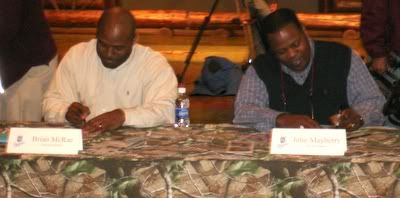
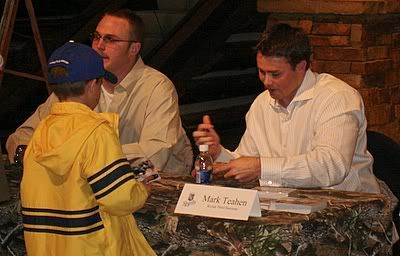
    I thankfully didn't say anything really stupid to Andrew Sisco, Mark Teahen, John Mayberry, and Brian McRae last night at the Royals winter caravan stop here in Springfield, but I wouldn't say I exactly executed my plan to say something clever to those guys either. The brief conversations I had with them were just simple, "Good luck in 2006" and "Thanks for everything you did in 2005"-type things.

    Sisco, however, had absolutely no difficulties cutting it up with the fans who showed up for the event. Consider this exchange between Sisco, Teahen, and myself after I took one picture with the two of them:

    : Yeah, do you guys mind if we take another one?
    : What happened? Did I blink?
    : Nope. Your face was is in it.

    To be fair, this was the first (and perhaps last) time I met both players, but Teahen seemed very sheepish and introverted, whereas Sisco was extremely outgoing and hilarious, displaying that special "it" quality few baseball players have. John Mayberry apparently has "it" too, talking about the days he was "knockin' 'em out."


    Brian McRae and Big John Mayberry signed away


    Andrew Sisco, a young fan, and Mark Teahen


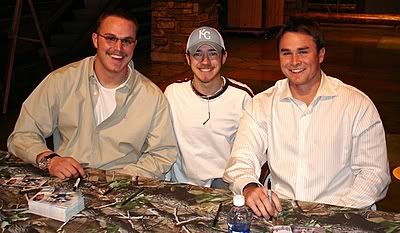
    Sisco and Teahen took time for a picture with KRB

    The caravan itself was kind of boring and disappointing, but sadly, it's become standard operating procedure for the Royals to mess up great opportunites to market their club and young key players in a positive light. It was great to meet a couple of guys who're going to be a part of The Next Good Royals Team, but is there any reason why the caravan has to be limited to being a quiet autograph and small-talk session? What's the harm in renting out a ballroom at a local hotel where so much more could be accomplished? I envision an event complete with a question-and-answer session with the players and announcers, autographs, and maybe a few jersey giveaways too.

    The Royals may be lousy, but that only provides extra incentive to make the team popular through intelligent and fresh marketing ideas. Nobody left Bass Pro feeling more excited about Royals baseball than they did when they walked in.

    And...

    BaseballProspectus.com is almost always on the cutting edge of baseball writing and analysis, but their latest project is one of the best baseball ideas I've ever seen.

    Ever since Hideo Nomo started the Japanese influence on Major League Baseball, there's been a question of how the leagues compare to one another. The question was raised again late this season when Bobby Valentine, the manager of the Japan Series champion Chiba Lotte Marines, told the Associated Press that "[He]’d put [the Marines] up against the winner of the World Series," going on to say that his team would "win at least a couple of games."

    Of course, such a matchup never occurred ... in real life. Enter the guys at Prospectus, who decided to start the "Battle of Champions," a seven-game series between the World Series champion Chicago White Sox and Valentine's Marines that will be simulated using Tom Tippett's Diamond-Mind Baseball software.

    However the series turns out, it's sure to be memorable. I'm going to keep a series tally on the sidebar, but don't forget to check out the full write-ups over at BP!