<body><script type="text/javascript"> function setAttributeOnload(object, attribute, val) { if(window.addEventListener) { window.addEventListener('load', function(){ object[attribute] = val; }, false); } else { window.attachEvent('onload', function(){ object[attribute] = val; }); } } </script> <div id="navbar-iframe-container"></div> <script type="text/javascript" src="https://apis.google.com/js/platform.js"></script> <script type="text/javascript"> gapi.load("gapi.iframes:gapi.iframes.style.bubble", function() { if (gapi.iframes && gapi.iframes.getContext) { gapi.iframes.getContext().openChild({ url: 'https://www.blogger.com/navbar/6246235?origin\x3dhttp://kevinagee.blogspot.com', where: document.getElementById("navbar-iframe-container"), id: "navbar-iframe" }); } }); </script>

Battle of the Backstops

Monday, January 31, 2005

The 2005 season is going to be a make-or-break one for a lot of Royals players, and for that reason, Spring Training 05 is going to be an open competition for jobs. Royals GM Allard Baird has made sure that everybody on the team knows that there won’t be any roster spots given away just because a player spent all of last season with the team. We can safely assume, of course, that anybody named Donald Zackary Greinke or anyone with a guaranteed contract would have to totally stink up the joint every time they take the field to be sent down, waived, or just plain released. The exercise is most likely directed at Ken Harvey, Chris George, Mike MacDougal, Jeremy Affeldt, and a host of others whom the organization may be running out of patience with.

Roster spots that carry very little importance in relation to winning baseball games are also up for grabs, most notably who’ll play once or twice a week as the backup to (probable) starting catcher John Buck. Unless the Royals do the unexpected and sign another catcher to a minor-league deal with an invitation to camp, that battle will be between the grizzled veteran (Alberto Castillo) and the not-so-grizzled veteran (Paul Phillips). Castillo spent time with the club last year when both Benito Santiago and Kelly Stinnett suffered season-ending injuries, and actually did a pretty nice job in the limited time he got to play. In 89 at-bats, he hit .270/.365/.371 and displayed a much-improved knowledge of the strike zone, drawing 14 walks while striking out only 10 times.

The improved plate discipline is why he even got a shot with the Royals in the first place. His defensive skills and ability to work well with pitchers are known throughout baseball; he’s thrown out 41 percent of the 250 guys who’ve tried to steal a base on him. Castillo’s problem is that he’s been so inept offensively, that he’s never been able to hold down a steady job even as a backup. Before Baird agreed to sign him last winter, Castillo had to agree to work himself into good hitters’ counts with greater frequency, and he did that at Omaha with 20 walks in 161 at-bats.

His competition, Phillips, is a guy who fans can’t help but root for because he’s persevered through a lot of bad luck to say the least. After being taken in the 9th round of the 1998 draft by the Royals, Phillips’ career got off to a darned good start, being named a Northwest League All-Star and being placed on the Short-Season All-Star team by Baseball America. However, his luck turned when he severely injured his elbow, had to have Tommy John surgery, and missed the 2001 and 2002 seasons during his recovery and rehab. However, he came back with a vengeance in 2004 following a sub-par 46 at-bat stretch with Single-A Wilmington in 2003. Calvin Pickering’s nightly demolition of Pacific Coast League pitchers must’ve slightly rubbed off on Phillips, as he posted a career-best .312/.358/.431 line as Triple-A Omaha’s starting catcher.

Choosing one guy to serve as Buck’s caddy isn’t the most important decision the Royals have to make by the time April rolls around, but it’s one they have to make nevertheless. What matters most to me isn’t what Castillo did last year, because although his improved plate discipline was nice, he still didn’t hit for any power, and his .736 OPS is likely just a good 89 at-bat stretch. In all probability, he’s going to revert back to his .600 OPS form of years past. 34-year-old catchers with 795 at-bats of downright terrible production at the plate don’t suddenly become decent hitters. The Royals should know what Castillo can do, so I think it’s time for Phillips to get his opportunity. He’s seven years younger, has done an okay job at the plate in the minor leagues, and was heralded as a solid defensive player coming out of Alabama in the late-90s. As a best-case scenario, Phillips probably isn’t going to have anything more than a decade-long career bouncing around as another Stinnett, but there’s a potential for him to be slightly better than that. The time has come for Phillips to show everybody what he can do, and he won’t get that opportunity if the Royals break camp with Castillo just to have an established veteran presence riding the pine five games a week.

Two thoughts from the weekend ...

  • My dream is to work in a baseball front office someday, and I started working my way up the long road on Friday. That afternoon, I went with a friend of mine to the Springfield Cardinals job fair, only to find out the atmosphere was way more like a test-taking classroom than the boisterous event I expected, complete with booths, PowerPoint presentations, and party favors. At any rate, we both filled out applications to work as ushers at Hammons Field and were interviewed in a very non-formal, getting-to-know-you kind of setting. One funny thing happened: During my sit-down with my interviewer Shannon, she asked if I had any sort of a problem working Friday and Saturday nights, seeing as I’m 20 and "probably like to hang out with [my] friends on the weekends," as she put it. I do enjoy going to movies and drinking cappuccino with all the great people I know, but my response was that I could think of far worse ways to spend weekend evenings than at a baseball stadium, even if I was working.

  • I was darned sure the SMS men would find a way to lose to the Creighton Blue Jays, but they held ‘em off, winning 80-73 and moving into a sixth-place tie in the Valley with Bradley. Additionally, it was way cool to see Anthony Tolliver, a friend of mine since grade school and the current starting center for Dana Altman’s team. Oh yeah, and then there was the shock of the night, 6-2" 3-point specialist Blake Ahearn’s breakaway two-handed slam:


    This season might not be over after all if the Bears’ vertically challenged players start throwing ‘em down with some regularity.

  • Happy Friday!

    Friday, January 28, 2005

  • Yesterday was a pretty busy day that ended with a late-night run with some friends to Potter’s House (a good place to get some coffee), so today’s entry will be a fairly short one. However, I’ve done quite a bit of planning and thinking in the past week about how KRB can take the next step towards becoming one of the leading Royals sites/blogs on the internet, and I’d really like some opinions and ideas from you, my oh-so-loyal readers. I’ve been working on setting up a couple of interviews with members of the Royals family, so that’s a start.

  • After watching some clips of the Royals’ mini-camp that was held earlier this month, John Buck appears to be a person who’s going to be the next KC player after Michael Sweeney wearing a "C" on his uniform. From the perspective of an outside observer, Buck played like a take-charge kind of guy from July to September, has continued to show off his work ethic by being in Surprise in January, and speaks like a leader. If he can improve his plate discipline a little bit, John’s going to be a heck of a good two-way player at catcher for the Royals, and an even better role model for younger players down the road.

  • If you haven’t seen this movie, I’d strongly recommend going to your local video rental store and checking it out:


    Maybe I’m just a sucker for stupid Leslie Nielsen-style humor, but Harold and Kumar Go To White Castle is one of the funniest movies I’ve ever seen. The entire plot is pretty genius, being based on two guys and the lengths to which they’d go to eat some White Castle hamburgers. In a way, it’s a story that could be loosely based on my senior year in high school. During journalism class, the three people who sat at my table and I would sign out of the room to "sell ads" to local businesses for our school paper, only to hop into my buddy’s Toyota Tercel, not actually sell ads, and go somewhere for lunch. That probably isn’t very impressive on the rule-breaking impact scale, but it was a thrill for us to work the system. The food destination changed with almost every trip, but every outing was a quest for fun right smack dab in the middle of the school day. Good times.

    Have a good weekend!

    In-Case-You-Missed-It Reading:

    The New/Old Pitchin' Coach (Thursday)
    The Horror of the Outfield (Wednesday)
    Jeremy Affeldt: Enigma (Tuesday)
    Juan Pierre: Best Thief? (Monday)

  • The New/Old Pitchin' Coach

    Thursday, January 27, 2005

    I was planning on writing a detailed entry about new (and former) Royals pitching coach Guy Hansen’s appearance on 810 WHB’s Hot Stove Show, but I thought kcroyals.com threw a wrench in those plans when they cut his entire interview from the archive. After reading a summary on the scout.com Royals message board, however, I’m now 100 percent convinced that The Fighting Allards have a real pitching coach in place. Although I’m no authority on pitchers, Bruce Kison, Mark Wiley, Al Nipper, John Cumberland, and Mike Mason are all just pawns in Hansen’s profession.

    Of course, it’s probably a little bit early to be getting all excited over the impact a new coach seems to be having, but optimism’s the key to avoiding insanity for Royals fans. It’s difficult for me to not crack at least a small smile when I read that out of the 33 pitchers who’ve been invited to Surprise, 22 have already worked with Hansen at one point or another this offseason. In Virginia. At an indoor pitching facility. Which is located in his backyard. Obviously he’s a guy who’s serious about pitching, and those 22 pitchers have a head start on their seasons and are better for it. Two of those pitchers – Zack Greinke and Mike MacDougal – worked with Hansen previously. Greinke learned from him when the Royals sent him to the Puerto Rican League as an 18-year-old, and MacDougal also soaked in some information in 2002 at winter ball. Everyone knows what Greinke’s become, and Doogie posted All-Star caliber numbers in the first half of 2003 before tiring out down the stretch. Take that for what it’s worth.

    I don’t know very much about Hansen’s tendencies and theories on pitching, but I’m very encouraged that he has confidence in himself that he can (and will) fix one of the worst pitching staffs in baseball ten years running. Here’s what he said shortly after he was hired last October:
    "What's hard for me to understand from a distance is that they moved the fences back and you still had all these negative pitching numbers. That's almost impossible to do. How do you get those numbers in a pitcher-friendly park? That will get fixed."

    "Basically [my philosophy is] pitch inside quietly, meaning don't be a headhunter. And what I've always stressed is the fastball in and the change-up down and away. I've always felt that the change-up is the most underused pitch in baseball. That won't be the case with the Royals next year. We will be keeping hitters off-balance."
    Talk is usually cheap, but since he’s worked in the Atlanta Braves organization for the past several seasons, I’m willing to give him the benefit of the doubt. After all, Hansen prides himself on having one pitcher – count ‘em, ONE – suffer an arm injury of any kind during his six years of work with the Braves. However, being a successful pitching coach entails much more than just keeping pitchers healthy and installing a philosophy that will work. It’s also about maximizing the ability of each individual pitcher. Two guys come to my mind when I think of Hansen’s top priorities when the team opens up camp late next month.

    Runelvys Hernandez

    Aside from Greinke, Runelvys Hernandez might be the most important pitcher on the 2005 staff. Before he blew out his elbow in 2003 shortly after the All-Star break, Hernandez was very good, posting a 3.05 ERA in in 62 innings. His strikeout-to-walk ratio (34-22) left something to be desired, but he has a fine 2.7-to-1 ratio in 370 minor league innings, and had a 2-to-1 ratio during his first major league stint in 2002. After sitting out a full season following Tommy John surgery, Runelvys has made a stronger commitment to adhering to a conditioning program. His unwillingness to train in ’03 caused him to gain a ton of weight from April to August, and therefore lost velocity and movement on his pitches.

    There’s very little wrong with his mechanics, so I’m optimistic that he’ll be ready to go on Opening Day, and perhaps even pitch against the Tigers. Sometimes, pitchers come back throwing harder than they ever did before after undergoing a ligament replacement operation. If Hernandez falls into that category and maintains his three other above-average pitches, he’s the best candidate to become Greinke’s right-hand man for the next several seasons.

    Jaime Cerda

    Sort of like Abraham Nunez, Jaime Cerda’s a little bit of a mystery to me, at least when comparing his major league stats to his minor league stats. It’s obvious that he’s a very talented pitcher, and therefore amazing that the Mets gave him away for a song like Shawn Sedlacek. Check out what Cerda’s done in his minor league career:

    IPERAK/9K/BB
    2191.118.933.88

    That, my friends, is dominance. Cerda had a really good 2004, and my only complaint is his terrible control (5.87 BB/9 IP), which was odd considering he didn't have that hard of a time throwing strikes in the upper minors. He countered his control problems by allowing a lone home run in 45 2/3 innings, and blew away left-handed batters, allowing them just a .185/.304/.215 line. At times, Cerda’s issues with throwing strikes consistently can be attributed to mechanics that cause him to rush his front half to the plate before his arm can catch up. If Hansen can solve that problem, I think Jaime has a good chance of having Mike Stanton’s career.

    The Horror of the Outfield

    Wednesday, January 26, 2005

    The time has come for Royals fans to brace themselves, because we’re staring the possibility of a Nunez/DeJesus/Long outfield to start 2005 square in the face. I know it’s only January and trades often happen all the way up to the last day of Spring Training, but color me unoptimistic that the Royals are going to get Austin Kearns or any other outfielder who’s been prominently mentioned in this space over the past couple of months. I’m not being my pessimistic self in this instance (at least not completely), because by all accounts, Allard Baird’s exhausted every avenue currently available to him to get this player. Call it being realistic … a not-so-happy realistic.

    As a result, if they really do intend on giving Nunez and Long a significant number of plate appearances next year, it’s important that they maximize the usefulness of both players. That means making the best out of a bad situation, which can probably best be done by platooning Matt Stairs with Nunez and Eli Marrero with Long. Since we pretty much know that T-Long brings a .770ish OPS to the table if the vast majority of his at-bats come against right-handed pitching, the question mark is the potential of Nunez, who the Royals have told to hit exclusively right-handed in winter ball.

    Since I became a sabermetric-devotee a few years ago, I can’t remember another player who’s had me so divided on what I think his ceiling as a hitter is. In other words, my brain doesn’t think much of Nunez’s potential in the least because he really hasn’t done anything in the minors that foreshadows a future regular corner outfielder. Sure, he’s done a really good job of drawing walks, but he’s been among the oldest players at each of his minor league stops since the 2000 season. He hasn’t hit for a high average (.263) or for much power (.444 slugging percentage) either. And in 221 at-bats with the Royals, all he could muster was a paltry .226/.304/.335 line, horrid for a guy who might be manning right field on Opening Day.

    However, the Royals insist there’s quite a bit of potential in him to be useful, and frankly, I can see it too. For one, having him try to abandon switch-hitting was a pretty intelligent decision. The numbers don’t show that he’s a superior hitter from the right side (which is becoming a theme in this instance), but I agree that he has a lot more power hitting right-handed. Also, Nunez is a pretty well-built guy who flashed a strong throwing arm and solid range in the outfield. In short, I see a guy who has all the physical attributes necessary to be a good two-way player. It’s going to come down to Abe transforming those tools into baseball skills. He’s off to a good start, hitting .283/.431/.428 hitting line for Estrellas in winter ball.

    Other stuff ...

    • As much as I hated ESPN.com’s Hot Stove Heaters selection of and reasons for Juan Pierre as the game’s best base stealing artist, I loved the article that named Brad Radke as having the best control in baseball. This article had everything the Pierre story lacked: Thoughts from fellow players who’ve actually played baseball, as opposed to unnamed "major league executives" and "talent evaluators." A couple of statistical tables that support the claim that Radke’s the best strike-thrower in the game. And perhaps most important, the article was just much better written, making it 100 percent more enjoyable to read.

      Not surprisingly, this one also had a different writer, a darned good one at that in Alan Schwarz. Many of you know Schwarz as the author of an amazing book on the history of baseball statistics, The Numbers Game, which has gathered many well-deserved praises since its publication. Anyway, in this article, Schwarz includes a table that shows not only the best strikeout-to-walk ratios from the 2004 season, but also one that displays a less conventional metric: Walks Per 36 Batters Faced. (Schwarz writes that 36 batters faced is "roughly a full game," but I think that number should be 40. Assuming there are no errors in the game, facing 36 batters over 9 innings works out to a WHIP of 1.00, which is just unrealistic. The 2004 American League WHIP was 1.41.) This could be a future "arbitration statistic" used in the defense of a more-hittable pitcher with great control, or against a less-hittable pitcher with great control.

      Additionally, Zack Greinke fell 17 innings short of qualifying for such things as BB/36BF, but in his age-20 season, he walked 1.56 batters per 36 faced. Had he been eligible, that number would’ve put him just behind Carlos Silva (1.45), just in front of Randy Johnson (1.64), and in the company of guys like David Wells, Greg Maddux, and Ben Sheets. Pretty heady stuff for a kid only three years removed from high school.

    • For any of the pro-Ken Harvey people who’re still out there, Baseball Prospectus’ player forecast system, PECOTA, has Big Calvin Pickering at a .943 OPS in 2005 (.400 OBP/.543 SLG). While I don’t think he’ll be quite that good, it’s pretty clear that somebody needs to make room for Pickering’s bat. Harvey, King of the Groundball Hitters, seems to be the obvious choice to me.

    Jeremy Affeldt: Enigma

    Tuesday, January 25, 2005


    After deciding to not tender a contract offer to Miguel Asencio (who signed with the Padres), the Royals only have one arbitration case to worry about this year, and that belongs to Jeremy Affeldt. This is his first year of eligibility, and he’s asking for $1.2 million while the Royals are offering $950,000. The two sides seem entirely too close to not reach an agreement before going through the ugly process, but every indication is that the case – for a reason unknown to me – is going before an arbiter sometime next month. The team would have to denigrate the player from every conceivable angle, but the Royals certainly couldn’t blast Jeremy’s sense of humor. When asked recently what the difference really was between $950,000 and $1.2 million, Affeldt quipped, "Two-hundred fifty thousand dollars."

    Anyway, this entry isn’t about choosing which 2005 salary most reflects his pitching abilities, or his prospects of becoming a standup comic after his playing days are over. I’m guessing neither topic would be very interesting to anybody, and going in another direction will let me to write about something I’ve been wondering about for some time: Does Affeldt really have the ability to be an upper-tier starter or closer?

    On the surface, the answer to that is an emphatic "Yes" for anyone who’s ever seen Affeldt pitch at full-throttle. When he uses maximum effort (which is only in relief appearances), it isn’t unusual to see him touch 97 and 98 mph with his fastball, and display one of the wickedest curveballs in the American League. There’s no question that he has the raw stuff to dominate even the best hitters, but more than a few pitchers with great stuff have flamed out for various reasons. Quite a few failed because their teams rushed them to the majors without allowing a proper development period at each level of the minor leagues, and part of me is afraid that’s what happened to Jeremy.

    Looking at Affeldt’s track record in the minor leagues is like watching Basic, or seeing something you expect to be good, only to have it disappoint you with confusing plot twists and a non-cohesive ending. After being drafted out of a Washington high school in the third round of the 1997 draft, Affeldt reported to rookie ball and had a predictable line that included a mediocre ERA, a low hit rate, and high strikeout and walk rates. The following season, he reported back to the Gulf Coast Royals, and showed some major improvements in control, lowering his walk rate from 4.7 to 3.9, and in missing bats, increasing his strikeout rate from 8.1 to 10.8. Because of those improvements, the Royals decided to move him up to Low-A Lansing near the end of the season, and that’s when his career started on this roller coaster that still hasn’t reached its conclusion.

    Affeldt struggled horribly for Lansing, allowing 27 hits and 18 earned runs in 17 innings, in addition to walking 12 batters and striking out only eight. He still had a pretty good season between the two levels, as his strikeout-to-walk ratio was over two-to-one that year. Despite his failure at Lansing, the Royals pushed him again, moving Affeldt to Charleston in 1999. His ERA improved to 3.83, but his strikeout rate took a big hit, falling to 7 per 9 innings, as did his walk rate, spiking to 5 per 9 innings. 1999 was the last season before the Allard Baird era began, so predictably, Affeldt was moved up – again – despite the fact that his peripheral statistics didn’t match his somewhat low ERA.

    In 2000, he was sent to Hi-A Wilmington, where he had a season that in no way resembled his last one. The hit rate? Up, from 8.8 to 9.7. Strikeouts? Down, from 7 per 9 innings to 5.6 per 9 innings. Often, such a drop in those key developmental categories can be attributed to a 21-year-old facing more advanced hitters, but curiously, Affeldt’s control improved despite everything else, walking a then-career low 3.6 per 9. In addition, he had a horrid 5-15 record.

    This is becoming a recurring theme: Even though Jeremy didn’t even come close to mastering Single-A, he was moved to Double-A Wichita in 2001, which was and still is one of the leagues least friendly to pitchers in professional baseball. A reasonable person would’ve predicted that Affeldt would get his butt kicked by a league known for its small parks and big hitters, but he did the opposite. He had a 3.90 ERA while improving his strikeout rate from the previous season to 7.9, lowering his walk rate to a very good 2.9 (46 in 145 innings), and as a result having the best strikeout-to-walk ratio of his career at 2.78-to-1. For a 22-year-old lefty to pitch like that in a known hitters’ league is very, very impressive, but there were still some concerns.

    For one, he was entirely too hittable, frequently allowing more than 9 hits per 9 innings of work. The explanation for that is his stuff back in ’01 wasn’t the same stuff he has now. Here’s what the 2002 edition of Baseball Prospectus wrote about a then much less talented Affeldt:
    Affeldt is a tall, thin left-handed starter who has been progressing in the shadow of the Royals’ better-known prospects. He only gets up around 90 with his fastball, but he mixes it well with a change-up and slurve. He keeps the ball down and in the park, which is how he succeeds without great strikeout numbers. Affeldt was named to the all-Arizona Fall League team despite being used in an unfamiliar role and having a couple of bad outings inflate his ERA to 7.25. His long-term outlook is as a swing man/spot starter.
    The only portion of that paragraph that applies now is that he’s tall. The rest of it changed drastically in 2002 when he took full advantage of his Spring Training invitation, flashing a much higher-octane fastball and a filthy curve nobody in the organization had seen before. Rany Jazayerli summed up his performance pretty well:
    This year, the kid is Jeremy Affeldt. On March 3, the southpaw took the mound for his first appearance and put on a pitching performance so astonishing that it headlined not one, but two separate columns in the Kansas City Star the next day. Affeldt struck out five of the six hitters he faced, and since these were the Pirates, one or two of them might have even been threats to put the ball in play. One observer, not normally given to hyperbole, told me that Affeldt's outing was, in a word, Koufaxesque. (This from someone who saw Sandy Koufax pitch many times.)

    [ . . .]

    One great outing doesn't make my heart race... but it's a lot harder for me to dismiss six of them in a row. Affeldt has now thrown 12 innings, getting nicked for a single earned run, allowing just six hits, walking two and striking out 14. His fastball is still getting clocked around 94 mph, and his curveball is still dropping as fast as the jaws of those scouts who watched him in his first outing. Last week he was brought in to face a tough lefty with the bases loaded and two outs, and blew a 2-2 fastball right by Jim Thome. (This sounds more impressive than it is, given that Thome has never been a world-beater against lefties.)
    And thus began the Jeremy Affeldt era in Kansas City. He posted a 4.64 ERA in ’02 with one of the best strikeout rates on the team, and then followed that up with an even better 2003 campaign that had everyone predicting a 15- or 20-win season for 2004. That season, he almost cut his walks in half (4.3 per 9 to 2.7 per 9), lowered his hit rate (9.9 to 9.0), and continued to do a fantastic job of keeping the ball in the park in what was then Coors Field East. Affeldt was especially dominant out of relief, posting a 2.56 ERA and 35 strikeouts in 31 2/3 innings.

    Then 2004 came, and Affeldt fell flat on his face just like the rest of the Royals’ pitchers and hitters. Even after he conquered a persistent blister by having half of a fingernail surgically removed, his performance fell off, but perhaps more concerning was his lack of velocity as a starting pitcher. He only worked at 88-90 mph in Spring Training, which should’ve been a major cause for alarm when he only struck out seven batters in 27 2/3 innings. As the season wore on, hitters seemed to ignore his big curve and focus on hitting the fastball, which had no life or movement. For the second straight season, he was more effective out of the bullpen with a 4.50 ERA, but his strikeout and walk numbers both went in the wrong direction.

    If you’re confused by Affeldt’s story, then you’re just like me. His career minor league numbers are less than spectacular: A 3.99 ERA, 7.25 K/9, and 3.94 BB/9 in 559 innings wouldn't scream "Top Prospect" to anybody. I can’t say I’m particularly optimistic that he’s ever going to figure it out because of his extreme inconsistency and the Royals rushing him to the majors, but a team should never give up on a lefty with his stuff. His future’s as a reliever, and hopefully the Royals will get 100 or more innings out of him in 2005.

    Juan Pierre: Best Thief?

    Monday, January 24, 2005
    Since the day I began making daily posts on this blog, I’ve gained an appreciation for just how difficult it can be for bloggers to write something(s) of quality every day. Some nights, I’ve spent half an hour fumbling around on my bookmarked baseball sites, hoping to just find an interesting topic to comment or expand on. The process of writing something for KRB typically starts at about 10:00 p.m. central time and, on most nights, the writing, re-phrasing, and formatting typically doesn’t reach its conclusion until 1 a.m. or later. In other words, rare are the nights when I’m able to simply dive into a subject I care deeply about, write about it non-stop, and have the article posted within an hour of when I started. I guess what all my English teachers have told me – that writing is a process and isn’t supposed to be easy – was actually good information.

    So on those nights when an inspirational topic won’t show itself, I often go hunting for an article that I can write a reaction to. Thankfully, that article was awfully prevalent right away because of this blurb that I saw Saturday morning on the ESPN.com front page:
    Sean McAdam tells you why the Marlins’ Juan Pierre is the best base stealer in baseball.
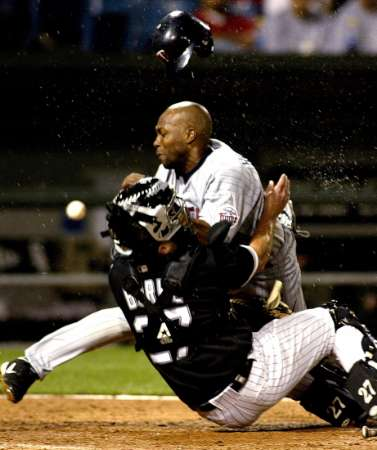
    McAdam’s article is a part of ESPN.com’s Hot Stove Heaters, a series of stories about which player’s the best two-strike hitter, the best prankster, the best-hitting pitcher, and so forth. Ultimately, they’re just supposed to be fun, opinion-based fluff pieces to get fans ready for the 2005 season, and that’s fine. I’m especially interested to read who they think is the best catcher at blocking the plate, because no play in baseball’s more exciting than a baserunner barreling into a catcher. Even after the play’s over, there’s the subsequent two seconds of suspense to see if the catcher still has the ball or, in Jamie Burke’s case, if he’s even still breathing.

    Most of the upcoming Hot Stove Heaters have to do with topics that couldn’t possibly be justified with any kind of a reasonable metric, like who has the most accurate outfield arm. However, some of them can be justified using statistics, and that’s exactly why I thought their selection of Juan Pierre as the game’s best base stealer was asinine at best … and that was before I even read the article. I knew that the premise was ridiculous to begin with (more on that later), but after reading the article, I found the reasons for the premise to be even crazier. Check out this excerpt:
    But one expert after another said Pierre is the guy they'd want running if they needed someone to steal a big base.

    "First of all,'' explains one major league executive, "he's got good instincts. Speed is one thing; instincts are another. He gets great leads, and that shows he's not afraid to get picked off. And that's another trait you look for: fearlessness. The great ones have it.''
    I’m at the point where I really want to stop putting any credit to things baseball "experts" say, and these people didn’t do anything to change that. A big problem with the "scouts" side of the "scouts vs. stats" debate is that the scouts often make judgments based on selective memory. For example, the perception is that Derek Jeter turns into a hitting machine in postseason play because of his November 1 homer and the Yankees winning championship after championship in the late-90s. The reality is that in 441 postseason at-bats, he’s hit .306/.380/.456, which is awfully similar to his career regular season hitting line of .315/.385/.463. In this case, these executives have determined that Pierre’s the best base stealer because of a few important (in their minds) times he’s succeeded, getting into scoring position at a crucial juncture of the game.

    As has been pointed out before on other sites, it’s important to have both sides of the scouts vs. stats debate implemented in baseball organizations for the team to achieve success. Similarly, it’s important for people to consider both sides when forming an opinion, the other side in this being using stolen base percentage. McAdam’s article also named a few other prominent stolen base guys like Ichiro!, Carl Crawford, and Scott Podsednik. I was shocked to see Carlos Beltran’s name missing from that list, considering that he’s the all-time leader in SB percentage, coming into 2005 at a healthy 89 percent.

    For me, there’s no better way to identify the best base stealer than by finding who succeeds the highest percentage of the time. Beltran’s success is extremely unusual, because he’s blowing Hall of Famer to-be and previous SB percentage record holder Rickey Henderson (80 percent) right out of the water. The general rule is that for a player to NOT hurt his team’s run-scoring ability, he needs to succeed on at least 75 percent of his attempts. Apparently, this fairly old Bill James adage is something that’s still lost on at least one baseball person:
    "He steals when it means something,'' says another talent evaluator. "He's not padding his total. Everyone knows he's going and he still makes it most of the time. That, to me, is the mark of a really great basestealer.''
    Once again, "He steals when it means something" is an example of selective memory. Additionally, "[Making] it most of the time" isn’t good enough, and it sure as hell isn’t "the mark of a really great base stealer." Knowing that Pierre couldn’t possibly have a higher percentage than Beltran does, I went to Baseball-Reference.com to do some checking, and found that Pierre’s career percentage falls at 73: Two percent below the important level previously mentioned. He was especially horrid in 2004, succeeding on just 45 of his 69 attempts for a 65 percent success rate.

    It’s one thing to use opinions and visuals to decide who the best in-game manager is, but it’s flat-out irresponsible to say that Juan Pierre’s a better base stealer than Beltran, Crawford, Suzuki, Podsednik, Johnny Damon, and a host of others. The bottom line is that the wrong choice was made here, because ESPN’s best base stealer has actually been hurting his team’s run-scoring outputs while on the basepaths.

    In memory ...

    If I may stray from baseball for a moment, I'd like to write briefly about one of my other loves -- comedy -- and about one of the pioneers of modern humor, Johnny Carson, who passed away yesterday morning.

    Carson's show was at its peak long before I was born and ended its run in 1992 when I was just eight years old, so I never had the opportunity to witness Carson's antics at the time. However, I've watched some Tonight Show highlights on VHS and laughed uncontrollably, mostly at his famous "Carnac" bit and his impersonations of Ronald Reagan. So even though Carson came well before my time, I was taken aback with shock and sorrow when I read yesterday afternoon that he'd died. My guess is that several others who're around my age had the same reaction I did. All of us can only hope to impact so many lives and become an icon as Carson did.


    1925-2005

    Aubrey Huff and a Parade

    Friday, January 21, 2005
    Another week’s passed, and the Royals’ search for an impact bat for the outfield still hasn’t reached its conclusion. Jeromy Burnitz is the only viable free agent option left, but they apparently don’t have any interest there. That means they’re down to making a trade or opening up Spring Training with Abraham Nunez and Terrence Long flanking David DeJesus in the outfield. Knowing that one of the two-headed Nunez/Long monster will have a starting job is bad enough; knowing that there’s a real possibility that both of them will open the season as regulars is downright scary.

    Because of that, the Royals need to hit the accelerator on trade talks for Austin Kearns of the Reds (who’re reportedly interested in Jeremy Affeldt), Jason Michaels of the Phillies, or – here’s a new one – Aubrey Huff of the Devil Rays. He isn’t technically an outfielder, since only 111 of his 454 career games have been played out of the infield or the DH spot. However, the Royals can’t afford to be picky with where they are right now, and Huff’s bat is far too good to pass up. The Rays are discussing trading him to Baltimore for a young pitcher and a young infielder, so I don’t see any reason why the Royals shouldn’t jump into the fray and see if Tampa GM Chuck LaMar would go for a package of Affeldt and Andres Blanco, Ruben Gotay, or Donnie Murphy.

    On a side note, I had the opportunity yesterday to talk to Parade Magazine contributing columnist Robert Moritz about this blog, why I started it, and why I enjoy writing it. Moritz – who seems like one heck of a nice guy – is writing a story about blogging for the magazine, and it’s likely that yours truly will have some quotes in the article. I guess it’s a little bit nerdy that I’m really excited about seeing my name in print, but I’m all for anything that’ll help this page reach even more people and hopefully continue to grow in popularity.

    Another New Guy

    Thursday, January 20, 2005


    Long ago when the Kansas City Royals were less than half the organization they are today, Tony Muser was running the show (albeit straight into the ground without any stops) and had a very weird affection for "scrappy" and "gritty" ballplayers, no matter how awful at baseball they actually were. Royals fans are too familiar with the list, which included Scott Pose, Hal Morris, Jeff Reboulet, and Luis Alicea among others. Additionally Muser, like many others, took notice of the Minnesota Twins when they started to grow into a respectable and then a contending ballclub. Not surprisingly, the Gunnery Sergeant thought the Twins were winning not because of their solid pitching staff, team speed, and defensive abilities, but because of their heart, hustle, and desire. No Twin fit that mold better than Denny Hocking, an untalented utility player who has to get his uniform dirty every night if he wants to continue playing somewhere. Muser loved that guy so much that he once said he’d rather field a team of eight Denny Hockings than a team of eight All-Stars. That team would probably score the fewest runs of any team in baseball history, but hey, at least they'd be trying!

    Anyway, Tony (wherever he is) is probably smiling right now, because Denny Hocking has fulfilled his destiny and is a Royal.

    This is another Allard Baird minor-league-contract signing that carries absolutely no risk, unless some sort of a plague strikes the entire infield and Hocking makes the team. Then – and only then – would the guy have any opportunity to play even sparingly. I think it’s pretty clear that the Royals still (correctly) view Chris Clapinski and even Luis Ugueto as better options to be the utility infielder, especially after Baird called Denny an insurance policy who understands the team’s rebuilding program. All of which is jargon for "He’s a nice guy, so we decided to let him hang out in Arizona for a few weeks." There’s no reason to get excited about this in either direction. He’ll either toil away at Omaha for the rest of the season or ask for and be given his release at the conclusion of camp

    Two other things ...

    • I have a confession to make: I love American Idol. I love everything about it, from the early stages that feature some of the cockiest bad singers anybody’s ever seen to the latter stages of the show, when I get to pick out my favorite performer of the final 12 contestants. As many of you know, season four of Idol started up the past couple of night with shows featuring auditions from Washington, D.C. on Tuesday and St. Louis on Wednesday, so naturally, I was glued to my TV for three hours of the last two days.

      The story of the first two stops wasn’t really the people who are horrifyingly bad at singing; those people are plentiful and you probably know one or two. To me, the story is the people who’ve convinced themselves that they’re good singers and "sound like Brian McKnight" as one man said last night before squeaking and squawking his way into Idol oblivion. After they’re told to leave, some of them stick around and make fools out of themselves for a few extra minutes, pleading for another chance because their "friends and family told me that I can sing!" Here’s a wake-up call: That’s called being nice and not wanting to hurt your close friend’s feelings. The show has drama. Ordinary people doing extraordinary things. Ordinary people doing not-so-extraordinary things and being chastised for even showing up. I can’t get enough of this stuff.

      An interesting bit of trivia: Of all the people put through to the round of 100 contestants so far (and there’ve been some extremely talented singers), one is Ozzie Smith’s son, who auditioned and was approved in St. Louis.

    • Esteban Loaiza signed with the Washington Nationals for a year and $2.9 million, or roughly what I thought he’d get. It’s kind of depressing, because I really wish the Royals had gone for E-Lo at $3 million rather than Lima Time! at $2.5 million. Even a 1995-2002 Loaiza’s clearly the superior pitcher, beating Lima in ERA, ERA+, K/9, K/BB, and H/9. Lima wins in excitement factor, but keeping the other players happy doesn’t win baseball games. Loaiza’s going to have a much better year than Jose will. Good signing by the Nats.

    Paging Mike Sweeney, Circa 2001

    Wednesday, January 19, 2005
    For the past several years, Mike Sweeney’s taken a lot of flak from fans for not staying healthy while collecting an $11 million paycheck every season. Much of it consisted of justified complaints; no fan wants his team’s highest-paid (and often best) player sitting on the bench because of a persistent back injury, since the team will probably be worse off because of it. Some of it, however, wasn’t justified, and those arguments were the ones that really got under my skin. Mike hasn’t been faking his back injury, and I’m sure he’s been doing everything in his power to return to the field on an everyday basis; it’s just that no remedy’s worked so far. I’ve made very few if any of either type of complaint about Mike since this back thing started becoming a persistent problem, mostly because I don’t see what good it’d do to scream about something I have no control over.

    None of that’s to say I’ve fully supported him either, because he’s one of the best right-handed bats in the American League when 100 percent healthy, and the Royals’ offense is far worse when he isn’t in the lineup. As a result, consider me to have been in the middle on this since 2002, the year Sweeney’s back flared up. Unfortunately, his comments in the Kansas City Star last week were discouraging at best to everybody who read them (including yours truly) because he, as a player who doesn’t make personnel decisions, doesn’t have much room to tell Allard Baird how to run his baseball team. Even then, I gave Sweeney the benefit of the doubt and just let the issue roll off my back, hoping the Royals would 1) handle it internally and 2) see it slowly fade away before pitchers and catchers report to Surprise, Arizona for Spring Training.

    And wouldn’t ya know it, they almost did both. However, "almost" only counts in horseshoes. Tonight, I write to you as a Royals fan who has never been more horrified in my ten years of pulling for this team. That’s saying something: Few things could be more horrifying than what the Royals have "accomplished" on the field since 1995. Sweeney and the Royals started off well with handling Mike’s statements internally. Sweens called Baird, who gave him David Glass’s cell phone number to call so the two could talk man-to-man. They spoke last night and the conversation was by all accounts a successful one, so that was a definite step in the right direction towards clearing the air with Sweeney’s grievances so both parties could move past it. In my opinion, that’s where this nonsense should’ve stopped, but Mike made damn sure that wouldn’t be the case when he called the Royals Hot Stove radio program to report to the world that everything’s okay.

    Did he stop and just talk about the upcoming season? Of course not, because he felt like taking some more potshots at the Royals’ brass in the way they’ve run the team. As I noted on Monday, Mike needs to realize that having a lower payroll and building from within is the way the Royals have to be run. What I forgot to mention was Sweeney’s additional need to stop complaining when the team releases or trades his best friends. For example, when Curtis Leskanic was given his walking papers in the middle of last year, Mike hung a picture of Lesky in his locker in a weird protest kind of way. During the interview, he continued to make reference to the Royals cutting "character guys like Brent Mayne," and that the biggest blows were the losses of Carlos Beltran and "my best friend in baseball, Joe Randa." Additionally, he was upset that his "good friend John Mizerock got fired because … apparently … we got thrown out too many times at home plate."

    Once again, that would’ve been a good place to stop talking, but he kept right on going … and painted himself into an even bigger corner, in my opinion. Listening to the interview, I heard a Mike Sweeney who didn’t sound sincere when he talked about how reassured he was that the Royals were, in fact, going in the direction winning ballclubs take. I thought he sounded very mechanical with his words, almost like he was told by the team to call the show and say what he did to Ryan LeFebvre and Denny Matthews. And what do you know? At the 23:19 mark of the interview, Sweeney dropped this:
    After speaking with Mr. Glass today -- and I spoke with Mr. Glass and Allard -- they said, "Mike, you know what? It’s a positive thing. You know, go out and tell our Royals fans that we hit a speed bump in the road, but we’re smooth-sailing now, everyone’s on the same page."
    He went on to call Glass a "super man" and Baird a "great GM," so he’s starting to backtrack a little bit on those apparently well-quoted statements in Jeff Passan’s article. It’s nice that he’s taking responsibility for his actions, but I’ve still had it with him. Although this really isn't for me to determine, I don't think he was being at all sincere in his explanation for going clubhouse GM on the guys who run the team, and that bothers me. Unfortunately, none of this is going to stop until Mike accepts that baseball is a business, and that the Royals can’t keep all of his buddies around for the rest of his career. Those players were let go because they either got too expensive or because their production was either in or likely to decline. In addition, there were younger and less-expensive players to come up and take their places. Sweeney’s a good guy with a good heart, but that heart of his is leading him to say and think things he shouldn’t.

    Mr. Cool

    Tuesday, January 18, 2005
    If you’ve ever gone to a movie with pre-conceived notion that it was going to be good or bad, you know that you’ve left either being disappointed or extremely surprised. I saw Coach Carter on Friday night with the idea that it was going to kick some major league butt. What did I think after leaving the theater? I’ll give you a hint: I wasn’t disappointed. There are so many things to like about this movie, mainly the basketball, the side stories, and Ashanti, but one person stood out like no other:


    I dare you to find another actor who’s cooler than Samuel L. Jackson. He’s had a long and storied career playing characters who don’t do anything except beat the crap out of people who look at him wrong, and that trait was oh-so-apparent in Carter. At one point in the movie, a disgruntled basketball fan pulls alongside Jackson’s car at a stoplight and spits in his face. A sane person would’ve stayed in his car, rolled up the window, and taken the high road (especially in the middle of traffic), but Jackson’s character did none of those things. But what did he do? Throw the car into park, get out, and try to pull the guy out of the car by his coat. It was quite the convincing performance.

    I’m not saying that Jackson would actually do something like that, because by all accounts, he’s a pretty nice guy. But I definitely wouldn’t want to cross him, the only dude in Hollywood who makes a beret look cool.

    Open Mouth, Insert Foot

    Monday, January 17, 2005
    My stupid mouth
    Has got me in trouble
    I said too much again
    --John Mayer, My Stupid Mouth--

    You know, the excitement offseason baseball news in Kansas City generates usually rates a Dick Cheney on the boring-o-meter (which is to say really boring), so it isn’t all that unusual for any story that has teeth behind it to turn the city’s fans and sportstalk radio pundits on edge. Last Thursday, Mike Sweeney gave KC its first talking point since the ever-so-thrilling Eli Marrero acquisition, so you’ll have to forgive those people if they seem to be going a little bit over-the-top with their takes on the issue.

    In case you aren’t familiar with what Sweeney said and what his statements mean when considering his background with the Royals, here’s a crash course: Apparently fed up with the Royals’ lack of activity in the free agent market, Mike said that he’d been “misled” by David Glass into believing that the team’s payroll would be steadily increased towards the $60 million mark. That was one of the promises Glass made, Sweeney said, when he and the team were negotiating his current five-year, $55 million contract in spring of 2002. As expected, Glass denied making such a commitment to Sweeney, which, of course, means that somebody’s lying.

    It’s important to note that Sweeney, while on the Royals Caravan in the winter of 2002, made similar comments after the Royals decided to slash payroll and drop expensive and under-performing veterans like Roberto Hernandez, Chuck Knoblauch, and Neifi Perez from the roster. Kansas City Star columnist Joe Posnanski wrote that the Royals should actually plan an annual Mike Sweeney “Rip the Royals” press conference. That isn’t such a bad idea; reporters could munch on chips and salsa while Sweeney has an airing of grievances Festivus-style. Anyway, the payroll is expected to be around $47 million at the very most in 2005, which means that on the surface, Sweeney might have a point about being misled.

    However, things always lie below the surface, and I think those things are what actually matter here. To me, whether or not Glass promised Mike a $60 million payroll isn’t all that important. No matter what was said during negotiations, Sweeney’s in the wrong on this, and is a prime example of why baseball players (and baseball fans, to an extent) shouldn’t have any say in how their teams are run. Apparently, Mike’s determined that having a higher payroll equals more success, which has been disproven time and time again in recent years. As those of you who’ve read Moneyball know, from 2000 to 2004, the Oakland A’s won more regular season games than the Yankees did, all while spending significantly less money. Maximizing your resources make it easier on a team to win in the short term, but it’s certainly no guarantee of a playoff appearance, and could have disastrous long-term effects, especially for a small-market team like the Royals.

    It’s for that reason Sweeney needs to take a step back and accept that building a base through player development is the way things have to be for the Royals. If he was told the payroll would escalate to a figure much higher than it is now, that’s something he’ll just have to deal with. The Royals of 2005 are a much different (and much better) baseball operation because they’ve dropped the payroll and, as a result, have been forced to make smarter personnel decisions from a financial standpoint. For example, keeping loyal Joe Randa around would’ve been nice, but with Mark Teahen knocking on the door, giving The Joker $2 million to play for two months and then be kicked to the curb wouldn’t have been a smart (or realistic) decision. The kids are on their way up, and this time, the rebuilding project looks like it’s going to generate winning baseball at Kauffman Stadium.

    The bottom line is that Sweeney needs to get on board with what the Royals are doing, or request a trade if he can’t. Just like Glass, I hope he wants to be a part of The Next Good Royals Team, because he’s a heck of a good guy and a good hitter. Unfortunately, his mind might be made up, making the likelihood of him finishing his career as a Royal about as high as Mike not missing 50 or more games next year.

    Thinking Ahead With Zack Greinke

    Friday, January 14, 2005
    You don’t have to wake up yet, but are you thinking seriously about it?
    --Adam Sandler in Spanglish


    With the Royals displaying an unparalleled lack of activity, I’ve found it extremely challenging to find interesting bits of Royals-related news to write about this week. That’s why I wrote two articles detailing two aspects of the Carlos Beltran signing and a short piece on the stir Randy Moss has created. With that said, one of the biggest challenges of keeping a blog up-to-date is being able to take an interesting person, place, event, etc. and putting one’s own spin on it. And when it comes to the Royals, no person’s more interesting than Zack Greinke.

    As foreshadowed above in that line from Spanglish, the Royals aren’t in a position where they have to get Zack’s name on a contract, but they at least need to be seriously considering it. I wasn’t able to find a list of the pitchers who’ve signed guaranteed contracts right after their rookie seasons (if there have been any at all), but my guess is that there’d be very little precedence for such a move. For one, young pitchers carry far too much of an injury risk and most don’t reach their highest potential. However, Greinke doesn’t fall into the category of "most pitchers" as any Kansas Citian will tell you. His risk of an arm injury is significantly lower than the norm because of his superb mechanics and, like Livan Hernandez, not using 100 percent effort on every pitch. Both aspects of his game put less strain on his arm. I don’t think there are many concerns about his long-term prospects either, especially after he more than held his own in 145 big league innings as a 20-year-old.

    Even if Zack or his representatives would listen to an offer of guaranteed money, I wouldn’t expect them to accept any offer that would buy out years of his free agency. The Royals don’t need to worry about that right now anyway, because they control his rights until the end of the 2010 season. Avoiding the arbitration process, however, is pretty darned important to a small-market baseball team too. Doing so creates cost certainty, even if the cost is slightly higher than what the team might pay in arbitration. Greinke’s well on his way towards becoming a star pitcher, so before his situation reaches the point that Beltran's did, I'd like to see the Royals show some confidence in the guy they're clearly building around. He's going to be very special and perhaps unlike anything baseball has seen before, so keeping him in Kansas City for as long as possible needs to be high on Allard Baird's to-do list.

    Guest Commentary: The New Mets

    -by Daniel Smith

    Well, it certainly was fun waiting for Carlos Beltran to sign with the team who offered him the most money, but now it's finally over.

    Perhaps it's just my nature, but did anyone really doubt that Beltran was going to the Mets, once the final figures were figured out? Sure, the Houston Astros' offer of six years and $100 million was great (further enhanced by the lack of taxes in Texas; say that ten times fast), however, the seven-year, $119 million offer from the Mets just had more juice. Giants fans should know the power of adding another year to a contract even if it's for less money per season, because that is exactly what lured Mike Matheny to move to the Bay Area. St. Louis offered him a two-year contract, and the Giants offered a three-year deal. In multi-year contracts, it's all about the number of years and the total dollars. The average dollars per season isn't quite as important in most cases.

    So where does that leave Beltran? In my opinion, utterly and completely stuck.

    The Mets have a long way to go before contending for anything is really possible. Another bat is mandatory (Carlos Delgado, perhaps?), and they could still use another starter or two, not only because their rotation isn't very good, but because the ever-fragile Pedro Martinez is always just around the corner from another arm injury.

    Last season, the Mets were 71-91 under skipper Art Howe. The only free agents they've acquired of any consequence to this point are Martinez (who they overpaid), and Beltran (who they just plain paid). How much of a difference will these two likely make? We'll do this the simple way: I'm just going to add up the Win Shares for each of the players acquired, and see where that would leave the Mets for 2005:

    Beltran: 31 [13 (Royals) + 18 (Astros)]
    Martinez: 17

    Adding those up we get a total of 48, meaning that those two -- should they generally repeat their performances of 2004 -- should be worth about 16 extra wins for the Mets, or about an 87-75 record. In 2004, if the Mets had an 87-75 record instead of a 71-91 record, it would have meant that they would still have missed the postseason.

    Of course, we can't just add on those two players' impact without accounting for those players they are replacing, in this case, Richard Hidalgo and Al Leiter. The Win Shares for those players are as follows:

    Richard Hidalgo: 7
    Al Leiter: 12

    Let’s see ... 48 minus 19 is 29 Win Shares of upgrades, or 10 more wins by replacing Hidalgo with Beltran, and Leiter with Pedro. Now the Mets' 71-91 in 2004 goes to 81-81 in 2005, and that, folks, is not enough. It's not enough to catch the Braves, and it's not enough to contend for the wild card. Heck, that may not be enough to beat out the Phillies and Marlins for 2nd place.

    The Mets have likely spent about 7.5 million extra dollars for 10 wins, and would probably have to spend at least $12 million more to get Delgado, which is good for about 6 or 7 more wins. It’s still not enough. While I understand the impetus behind moves like these (keeping up with the Yankees in the media), I don't understand why the Mets don't spend money more intelligently to strive for the real prize: Beating the Atlanta Braves, for once. The Mets have Beltran, and they have Pedro, but they don't have much else.

    Notes for a Thursday

    Thursday, January 13, 2005
    • The aftershocks and overreaction to The Mooning Incident are continuing to roll in. Vikings owner Red McCombs has demanded that FOX remove Joe Buck from the play-by-play booth this Sunday for the Vikings/Eagles matchup, which I think is complete nonsense. Before I get any e-mails blasting me for being hypocritical because of what I wrote yesterday, I still think people are wrong for treating this like it actually matters, and that Joe Buck calling it a "disgusting act" is just plain stupid. However, McCombs is overreacting to the original overreaction, saying that Buck is somehow prejudiced against the Vikings, and is so scarred by what he saw that he won’t be able to keep his objectivity on the telecast.

      I don’t really know why McCombs chose to suggest such an asinine thing, and I especially don’t know why he didn’t feel the need to elaborate on it any more than he did, which was a two-sentence memo. I do know that Joe’s one of my favorite announcers because of his objectivity (unless he’s doing a Cardinals game on Fox Sports Midwest), which is to say he doesn’t pick sides when he makes fun of everything and everybody at every opportunity he gets. The "Slama Lama Ding Dong" commercials are priceless, too.

    • Allard Baird’s been doing an awful lot of radio interviews in the past few weeks for a guy who supposedly isn’t up to anything. He last appeared Tuesday on the debut of the Royals Hot Stove show, and essentially gave a preview of the 2005 club and what’s ahead in the coming years. That was the boring part of his discussion with Denny Matthews and Ryan LeFebvre. In most every interview I’ve heard with him since the complete rebuilding project started back in 2002, Allard’s talked about the importance of the Royals having young pitchers and young hitters come up in unison. It’s taken them awhile, but it’s finally starting to happen, and most if not all of the credit should be given to Baird.

      He made some pretty disastrous moves prior to the 2002 offseason, but since that point, he’s ensured that the light at the end of the tunnel isn’t coming from a freight train. I can’t believe the guy still has to hear criticisms after loading up the farm system – every level of the farm system – with quality young players. He’s done it through the draft, popping blue-chippers like Zack Greinke, Billy Butler, Chris Lubanski, and J.P. Howell, and under-the-radar guys such as David DeJesus, Brian McFall, and Luis Cota. He’s also started to earn a living by robbing teams of their better prospects; I’ve yet to send Mike Flanagan and Jim Duquette their thank-you cards for Denny Bautista and Justin Huber, respectively. John Buck, Mark Teahen, and Mike Wood only cost the Royals half a season of Carlos Beltran, who wasn’t coming back anyway. Many of these guys are already at the major league level, and many more – Teahen, Huber, and Butler – aren’t far away in the least.

      For a guy who inherited an extremely barren pipeline of young talent, I think Allard’s done one heck of a good job in a relatively short amount of time. And for the first time in a long time, the Royals are headed in the right direction. The only thing left to do is finish the job by turning these young players into "dependable production guys," as Baird would call it. The right players are here, and the right man’s running the show. Finally.

    • There’s a movement in the North Dakota legislature to make Roger Maris a member of baseball’s Hall of Fame. While I don’t want to rain on their parade, as I’m sure Maris is a beloved figure in his home state, I’m afraid this might pick up some steam and place an undeserving player in the Hall. The resolution says that Maris "probably achieved more in baseball with less appreciation [ . . . ] than any other player." All of that’s probably true, but the Hall of Fame is reserved for greatness, not players who were merely good as Maris was. If he wouldn’t have hit 61 homers 44 years ago amid all that Babe Ruth hoop-la, I don’t think anybody would even be considering this right now.

      One other thing … According to Bill James’ similarity scores, the player most similar to Maris is none other than Jeromy Burnitz, who I don’t think will be seeing anybody’s Hall of Fame anytime soon. It’s a nice gesture on the part of Roger’s home state, but it’s also one without any merit or base.

    Chill

    Wednesday, January 12, 2005
    Kevin’s Royals Blog received a pretty significant promotion today that’ll likely springboard its number of readers. At least that’s what I’m expecting after Aaron Gleeman (who runs arguably the most popular baseball blog in the blogging business) added a link to this page on his. I’m pretty sure this is both a blessing and a curse, because while more readers means more recognition, it also means more pressure to post something (or more than one something) of quality every weekday. I think I’ll be okay, though. After all, I only started this blog so I could have my own forum to talk baseball and share my thoughts with other baseball fans out there. I’m doing what I love and love what I’m doing, and this significant step forward is an awesome feeling.

    Moving on to another topic at hand, I’m starting to wonder about the sanity of American society, especially that of those who attend and watch sporting events. As I’m sure most of you are aware, after scoring a second-half touchdown in the Vikings’ win over the Packers on Wild Card Weekend, Randy Moss did what star wideouts do nowadays: Celebrate the score in a creative fashion. However, Moss’s creativity in this instance involved pretending to pull his pants down and moon the Green Bay faithful:


    I laughed, because my knee-jerk reaction was thinking, "That’s clever. Never seen that before." Without giving it another thought, I proceeded to continue eating my chicken caesar salad wrap from Ebbets Field. That was it.

    However, it seems that most everybody else who witnessed such a "horrifying" thing on television either can’t or doesn’t want to let it go. Joe Buck, who was announcing the game, denounced the action. Stuart Scott, while doing the game highlight on that evening’s SportsCenter, called out Moss not once, but twice, calling his end zone dance "distasteful" and then "once again – not in good taste" in the span of two minutes. Art Hains, who’s an excellent host of the local evening sportstalk radio, thought it crossed the line too.

    After hearing all of the evidence and opinions and having time to re-form mine, I’ve decided that Randy’s moonwalk was probably more stupid than funny, but I’m still not offended by it like a lot of other people seem to be. Maybe I’m just too young to care about that sort of thing, but the way I see it, if he’d actually pulled down his pants in front of 70,000+ at Lambeau Field and millions more watching on national television, THAT would’ve been distasteful/ugly/inappropriate. However, he didn’t. In fact, I’m thankful he’s caused another stir, because it’s only with additional Wardrobe Malfunctions and Sharpie Incidents that we as a society will be able to address our tendency to be overly sensitive, especially when sports are involved.

    It just isn’t right that the Terrell Owenses, Randy Mosses, and Jose Limas of the world are often criticized (and sometimes fined) for doing some showboating after scoring a touchdown or, in Lima’s case, picking up a key strikeout or two. I enjoy watching those guys play too much to care about the extracurricular stuff they do on the field, which I think just adds a whole other level of fun to the game. The purist crowd who enjoys picking on these players is slowly evaporating, I think, but there are still a few out there who just need to lighten up a little bit. None of this stuff is hurting the integrity of the game or the individuals who play it.

    One other thing ...

    As of right now, Opening Day is 81 days away, but my Opening Day’s going to come a little bit sooner. On April 2, Hammons Field will officially be christened when the St. Louis Cardinals come to Springfield to take on the Springfield Cardinals as a final tune-up for the regular season. I have my doubts that we’ll see any more than just one plate appearance for guys like Edmonds, Pujols, and Rolen, but it’s going to be awesome nevertheless. Many summer nights are going to be spent at that beautiful stadium this year. If you guys and gals are interested, I might post some pictures and detail the games I go to, which is going to be every game possible.

    The Personal Side

    Tuesday, January 11, 2005


    I think all of us had a pretty darned good idea that whenever and wherever Carlos Beltran decided to sign, that there’d be an abundance of hoop-la surrounding his introduction. However, I never had the slightest clue the news would be this big, even having the knowledge that he was probably going to end up in the king of all baseball cities, New York. Already, I’m starting to see the significance of this addition being compared to the Mets acquiring Gary Carter after the 1984 season to counter the Yankees’ signing of Rickey Henderson. To make a long story short, Carter had a good couple of seasons with the Mets, who won the World Series in 1986, while the Yankees never even reached the playoffs in Henderson’s five seasons with them. Yes, it’s all about the battle for the back page.

    Fast-forward to 2005, and we’re seeing the same thing happen again. Barring another incident involving some dude and a camera, the Yankees are going to introduce Randy Johnson tomorrow. Three hours later, Omar Minaya will be talking up Beltran’s merits at Shea. The arms race between the Yankees and Red Sox is now obsolete; the chic Cold War is back where it belongs: A battle between the Home Run Apple and the voice of the Bronx, Bob Shepard. A dogfight involving Death Valley at the Bronx and Death Outfield at Shea. Minaya v. Cashman. Wilpon v. Steinbrenner.

    The pressure’s never been higher, and right in the thick of it is Beltran, the man of the hour. Part of me wonders if he – or anybody, for that matter – is cut out to handle the cooker he’s about to be thrown into. Playing any sport in New York is a skill that’s too often ignored by both the media and performance analysts. If you have any doubts, just ask Jeff Weaver, who wasn’t even making a ridiculous amount of money. After all, when a player makes $17 million a season and plays for the Mets, Yankees, Knicks, or Rangers, performing up to expectations is never enough, and God help anybody who fails.

    The question is if Beltran’s got the kind of thick skin to handle the boos and disparaging articles that will surely be fired off the instant he falls into a 1-18 slump in the middle of June. Although I don’t know him personally, my opinion is that if anybody can deal there, it’s Carlos. As Allard Baird noted in a Monday Kansas City Star article, his former star center fielder separates the game on the field and the emotional side of baseball better than most, and isn’t going to get caught up in drama, night clubs, and the night life. However, I think this marriage is going to take a little bit of work and some give-and-take by both the player and the fans in this instance. Beltran’s going to have to open up a little bit more, be more of a clubhouse leader, and be patient with the media. (See Pennington, Chad.) Mets fans? Well, they need to realize that Beltran’s a shut-up-and-play kind of guy if there ever was one. It isn’t in his nature to lead in any other way than by example, so patience is needed there too.

    There’s going to be an adjustment period for Beltran, but as one of the classiest individuals in baseball, I don’t think he’s going to have much trouble at all adapting away from his more hometown-like previous baseball stops in Kansas City and Houston.

    Carlos Beltran: Chasing the Money?

    Monday, January 10, 2005


    On Friday, I made a few predictions for the weekend, and all three of them came true. Firstly, White Noise was a pretty awful movie. It’s supposed to be a film about dead people re-connecting with their loved ones through radio stations, television static, cell phones, and anything else with a screen and a wire, but the only spooky thing calling from the grave here is Michael Keaton’s career. Secondly, the Royals did continue to remain dormant, but I think they’re going to have their 2005 starting left fielder under wraps by the end of the week. Whether that guy’s going to be a trade acquisition like Austin Kearns for the long-term picture or a stopgap guy like Danny Bautista remains to be seen, but Allard Baird wants the situation resolved soon.

    Although the result of my third prediction isn’t official yet, it might as well be. Every credible sports website known to man is reporting that Carlos Beltran and the Mets have agreed in principle to a 7-year contract worth $119 million, breaking the hopes of Cubs, Astros, and Yankees fans, among others. The "others" would be fans of every other team in baseball, even if their team didn’t even place a phone call to Scott Boras regarding Carlos at the end of last season. Because Beltran spurned the Astros’ offer of $100 because he could get an extra $9 million from Mets owner Fred Wilpon, the fans and some members of the media have taken the liberty of bashing him for being all about the money and only about the money. To an extent, I can see where these people are coming from, if only because nobody really likes the power of New York baseball’s resources and because Beltran was so much fun to watch as a ‘stro last October.

    Ultimately, this isn’t a question of whether Beltran’s worth is more than, less than, or equal to $100 million. I don’t think you’ll find many people who can successfully argue that the Mets overpaid to get him, because he’s a player who seemingly has an endless well of baseball skills he can use at will. What’s at stake here is the same debate baseball fans had four years ago when Alex Rodriguez entered into the largest contract in baseball history with the Texas Rangers. It’s a societal question of whether baseball players – especially the premier ones – are morally justified in maximizing their monetary value on the open market rather than taking less to stay in the place (often a small-market place) where fans fell in love with him.

    As a big fan of the very small-market baseball team that drafted, developed, and reaped the rewards of Carlos Beltran, I understand the frustration of the many people who so desperately wanted him to shun the really big dollars and stay with the Astros. Doing so would’ve been a major feather in his cap, and a major black mark on the record of Boras, which I think we would all like to see someday. If we’re going to blame anybody for Beltran not taking less, we should be blaming Boras, who pretty noticeably played Astros GM Tim Purpura, using his team as bait for the New York clubs to get involved in the bidding war. As a result, nobody should be shocked that Beltran made this decision, because it was made the day he hired Boras to be his agent. Let’s be real here: Scott Boras clients don’t sign with teams that won’t get them the most recognition, the most money, and the most fame. It’s that word – "most" – that bothers baseball fans, because we can’t comprehend being offered hundreds of millions of dollars and turning it down just to get a few million more. The reality is that for every Jose Vidro and Mike Sweeney who sign for less than they could get on the open market, there are probably for or five guys who’re only interested in playing for who’ll write the biggest check, winning baseball games be damned.

    The justification of such an action can be extremely difficult to pull off. When the Mets announce Carlos as their latest big-money acquisition, fans aren’t going to want to hear him say, "I came here because I want to win" when the informed know that Houston probably has a better chance of winning than the Mets do. Would it help ease the pain if Beltran admitted he chose New York because they offered more? Perhaps a little, but never entirely. I think what would help more would be all of us being more realistic, getting off our soapboxes, and putting the morality card down. Carlos served his six years of not being able to choose his destination, and according to the rules, he’s allowed to market his services however he pleases. Whether his decision was based on greed shouldn’t concern us in the least. He’s playing by the rules just like everybody else, and doesn’t deserve to be bashed for maximizing his value.

    Other stuff ...

    • After bringing Odalis Perez back for a more-than-reasonable amount of money, the Dodgers are reportedly on the verge of adding Derek Lowe to an already pretty-good rotation. 4 years and $36 million is excessive for a pitcher of his talents, but I’ve given up on complaining about teams vastly overpaying free agents this winter. Therefore, the only real issue here is just how good Lowe’s likely to be pitching in Dodger Stadium. I think he has an opportunity to be very good and post some sub-3.50 ERA seasons as long as he has a solid infield defense playing behind him. Derek’s never struck out a lot of batters (career 5.88 K/9), but he’s one of the most extreme groundball pitchers I’ve ever seen, getting 3.34 grounders for every flyout in 1,090 innings.

      Replacing Alex Cora with Jeff Kent is quite the defensive downgrade, but Jose Valentin, the team’s likely third baseman, is a guy with good range. Cesar Izturis justifiably won a Gold Glove as a shortstop a season ago, and Hee Seop Choi’s soft hands and footwork are reminiscent of Todd Helton’s, one of the premier defenders at first base. Lowe’s going to need all of them to field like crazy to earn his $9 million a season, but his good control and ability to keep the ball in the park should make him a valuable option every fifth day.

    • As reported previously in this space, Dave Haller got his 30 seconds of fame on Saturday morning, as he was allowed to make a few comments on Baseball Prospectus Radio. Apparently, he didn’t freak out and stutter like I probably would’ve done given the same scenario, so mad props go out to that guy. If he wants to take baseball on as a career, he has the ability to be a big-time GM prospect in four or five years.

    Friday, January 07, 2005
    The Royals invited five more players to Spring Training yesterday, but I don’t expect any of them to be anywhere else except on a minor league roster in 2005. Starting pitcher Ryan Jensen and infielder Luis Ugueto will likely be members of Triple-A Omaha’s rotation and bench, respectively. Emil Brown was also signed; he’ll likely have an outfield spot at Omaha. Pitcher Jonah Bayliss and infielder Darren Fenster are both organizational-type players, and they’ll likely spend 2005 at Double-A Wichita.

    By the time this weekend’s over, Carlos Beltran will probably be a Met or an Astro, the Royals will have continued to do absolutely nothing, and I’ll have seen White Noise, which I’m sure is going to be terrible. Have a good one, kids.

    One other thing ...

    Thursday, January 06, 2005
    Aaron Gleeman's posted an amazing article that's partly about the 2005 Hall of Fame results, and partly about baseball fans who still just don't "get it." This goes beyond sabermetrics, too. It's about some people who'd rather evaluate players by what they saw and only what they saw, as opposed to considering that maybe these "stats" actually are useful.

    Strike One Against Ashlee

    I was one of a select few people who chose not to watch Matt Leinart & Co. beat the hell out of the Sooners on Tuesday night. The reasons are four fold.

    1) I don’t particularly like college football
    2) If I suddenly did start to like college football, I could catch the highlights on SportsCenter
    3) I think the Bowl Championship Series sucks

    The fourth reason is that important sporting events like the Orange Bowl are always guaranteed to have some distracting and unnecessary halftime show, usually featuring performers who have nothing to do with sports. Yesterday, I saw what I missed of those festivities and not only am I glad I missed it, but I was also horrified at Ashlee Simpson’s "performance" of her newest single, LaLa.

    I only caught the last 25 seconds or so of her set, but I think I got the picture of just how bad it was. Heck, she got booed off the stage by like 80,000 football fans, and some of the booers were probably college-aged guys such as myself. To be fair, I think you’ve got to cut any singer some slack when he or she performs live, because nobody’s as good as they sound on a CD, and nerves definitely play a role. But this … monstrosity crossed the line. She forgot the words to her song, replacing "french maid" with "lemonade", sang horribly off-key throughout, and did some really, really stupid dance moves.

    Ashlee hasn’t lost her place as the official fantasy girl of Kevin’s Royals Blog because of that, but another one of those, and she might be out. Catherine Bell’s in the on-deck circle:


    By the way, David Haller of Knuckleball Sandwich might be on Baseball Prospectus Radio this Saturday. Those of who’ve read his blog know that Dave knows baseball. For those of you who haven’t read his blog, what in the world are you waiting for? Either way, when I hear what time he could be on the air, I’ll pass that bit of news along because you don’t want to miss it.

    Just Some Stuff

    Wednesday, January 05, 2005
    • As I mentioned in yesterday’s crack-of-dawn mini-post, I planned to write about the Randy Johnson trade today. However, John Barten from ‘Till You’re Blue in the Face beat me to the punch with his blasting of the disaster site that is the Arizona Diamondbacks. He pretty much summed up my thoughts in an exact fashion; I don’t really have anything to add, so I’m just going to bow out on writing a long version of that topic. The ‘backs just need to take a long look in the mirror, realize they aren’t in the "success" part of their success cycle, and stop handing out lucrative contracts to big names with injury problems (Troy Glaus) or who’ve been overvalued (Russ Ortiz).

    • If I were a member of a front office, I think I would be willing to acquire and put up with a good player who has a slight attitude problem as long as he produced on the field. However, if there ever came a time when my tolerance level with the player exceeded his production, that player wouldn’t have a bat in his hands on the first day of Spring Training, he’d have a plane ticket out of town.

      Obviously, I don’t have first-hand knowledge of how the Dodgers brass views Milton Bradley, but apparently his behavior hasn’t reached their Boiling Point yet. They gave Bradley a one-year deal yesterday worth $2.5 million to avoid arbitration, which really surprised me. What he does well on the field – draw walks, hit for moderate power, and play a pretty darned good centerfield – is probably worth the money, but in my opinion, his off-field problems don’t make the Los Angeles organization look good. Heck, I think they’re far worse than anything Barry Bonds has ever been criticized for.

      Milton’s had a history of not controlling his temper on the field and not being able to stop himself from screaming at news reporters, but those incidents aren’t what I’m talking about. In August of 2003 (while he was still with the Indians), Bradley was pulled over by police for driving 52 mph in a 25 mph zone. What did he do? The dumbest thing possible to do in that situation; refuse to sign the speeding ticket, roll up his window, and drive off. He served three days in the hole for that offense last month. In November of last year, he was charged with disorderly conduct in another traffic-related incident in which he interfered with another person’s traffic stop. He could get another 30 days in jail for that offense.

      I know Bradley’s a valuable piece of a winning baseball team, but enough’s enough. The Indians cut bait with him, and I think it’s time for the Dodgers to do the same. Bradley’s tolerance level has exceeded his production, and LA’s too classy of an organization to be related to nonsensical behavior like that.

    • It takes a keen eye (and a little bit of optimism) to see that what Allard Baird’s doing in the present is going to make the Royals a much better team in the future, but the need for that keen eye is becoming less and less as days go by. As Baseball Prospectus noted in their 2004 Royals team essay, "A re-examination of his two most notorious trades are in order, because understanding why he made them is key to understanding what’s really going on in Kansas City." While the Damon and Dye trades aren’t relevant to this discussion, the second part of the sentence – understanding what’s really going on in KC – is very relevant. What’s going on is a continuous string of good decisions that was only slightly interrupted by the questionable signing of Jose Lima.

      The latest good decision came today when Shaun McGinn, formerly the director of player development, was bumped up to Senior Director of Minor League Operations. Sure, it’s a move that won’t make a bit of difference in the on-field product directly, but McGinn thinks along the same sabermetric lines Baird does. The Royals haven’t had any success in drafting and developing players from their farm system, but they have a great trio in place – Baird, McGinn, and Senior Director of Player Personnel Donny Rowland – to reverse that trend.

      The Next Good Royals Team has started with Zack Greinke, and it’s going to continue with Justin Huber, Billy Butler, John Buck, Mark Teahen, Denny Bautista, David DeJesus, and hopefully Justin Upton after the Royals pick in this June’s amateur draft.

    • Speaking of young Royals players, it was reported in an mlb.com article today that with the Reds having cut bait with Barry Larkin and youngster Anderson Machado injuring his knee (perhaps seriously) in winter ball, that the Reds might be willing to part with Austin Kearns to get Andres Blanco. The Reds want to find out just how serious Machado’s knee injury is before making any sort of a move, but this would be a fantastic trade for the Royals if they can get Reds GM Dan O’Brien to bite. I have serious doubts they’d part with Kearns for Blanco alone, so Allard should be willing to include two or three other quality young players to get the deal done. After all, they have an excess of young pitching and middle infielders to deal.

    I'm Tired

    Tuesday, January 04, 2005
    I got in very, very late last night, so I went to bed after some feeble attempts at 1:30 a.m. freewriting went nowhere. I promise I'll be back tomorrow, probably with a look at the Randy Johnson/Javier Vazquez/Shawn Green deal. I assume it'll be at least pretty darned close to being completed by then, meaning the Dodgers will be the only team that came out as a winner. The losers will be the Yankees, the Diamondbacks, and Shawn Green, who will be playing for the Diamondbacks in 2005.

    Until then, Daniel wrote a pretty good article on his blog about who should hit in front of Barry Bonds. For you Royals fans out there, I'd recommend checking out RSTN.tv's video archive. If you scroll all the way to the bottom, you can watch the last two good memories the Royals gave us: The 2003 season and Opening Day '04. Lastly, I added some additional things to the sidebar last night in case you didn't notice. It's just some of my favorite non-baseball stuff and people in the whole wide world. That, or phase one of renaming this blog "The Ashlee Simpson Shrine."